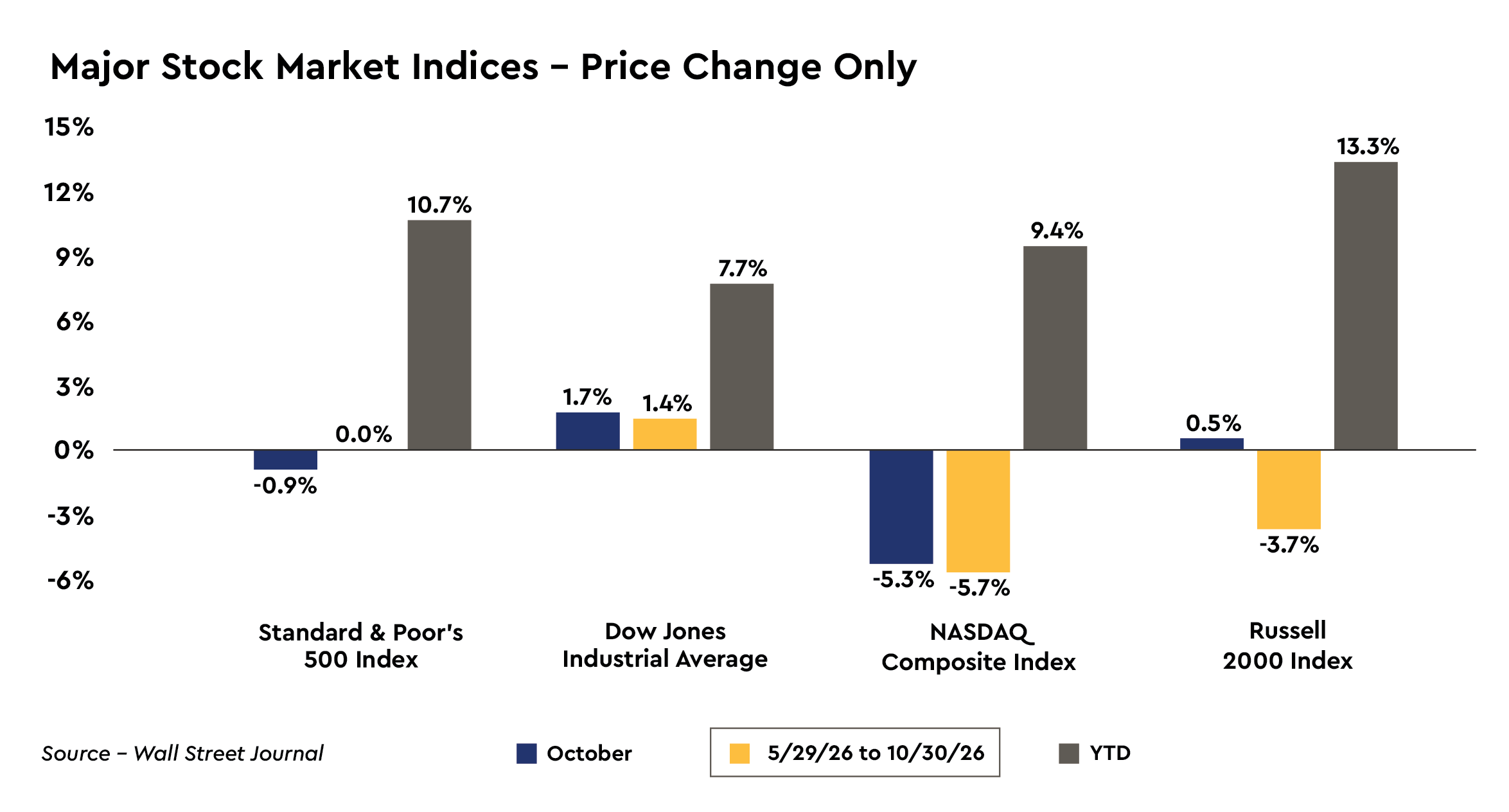
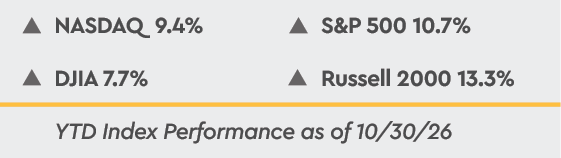
Looking forward, with inflation being reported at 3.7% over the past year for both the PCE price index and the CPI and being above the central bank’s 2% target for five and a half years, we think the Federal Reserve is likely to raise rates at the December 8-9 FOMC meeting as it risks losing credibility with investors of it does not. The FOMC Committee has boldly closed the last four policy statements with ”The Committee will deliver price stability,” and the markets appropriately expect a certain amount of action toward achieving that goal.
Could the Iran Conflict Be Reaching a Tipping Point?
Oil is reportedly moving through the Strait of Hormuz with most Gulf nation crude exports well above their March/April lows, and in fact on certain days exceeding their pre-war levels. Iranian volumes are the exception as crude exports from Iran are virtually nonexistent. This outcome has kept global oil prices from spiking further while squeezing the Iranian regime. From the little information that trickles out of Iran, it appears the Iranian economy is in free fall with inflation near 100% as Iran’s currency is basically worthless with widespread shortages of basic necessities, fuel, and foodstuffs.
With Iran losing $100 to $200 million a day in oil revenue and the extremely harsh economic sanctions that were put in place in August, the regime cannot pay government workers, military personnel, and importantly, the members of the IRGC, the powerful political, military, and economic force that dominates Iran, defends the regime, and coordinates Iran’s war effort. It is unclear how much longer the Iranian regime can hold on, but its staying power does not look very good as economics aways wins out in the end. In our view, caution and patience should guide U.S. policy on Iran, as it appears time is on the side of the U.S.
Booming Earnings versus Mounting Challenges to the Outlook for Stock Prices
Investors are facing a highly volatile period of time due to uncertainty over oil prices, myriad risks from AI-related technology companies, massive federal budget deficits that are weighing on the credit markets facing outsized AI buildout credit demands, uncertainty over the outlook for fiscal policy and regulatory efforts in the aftermath of the midterm elections, and Federal Reserve policy over the next 7-8 months with inflation above the central bank’s 2% target.
While there is plenty to challenge the stock market in the near term, the outlook for common stocks ultimately comes down to the outlook for the economy and earnings. The economy is set to enter 2027 with solid forward momentum, although the economy’s growth rate should slow from the strong growth rate of 3.4% in 3Q 2026. Meanwhile, the earnings trajectory is nothing short of spectacular with profit margins at record high levels.
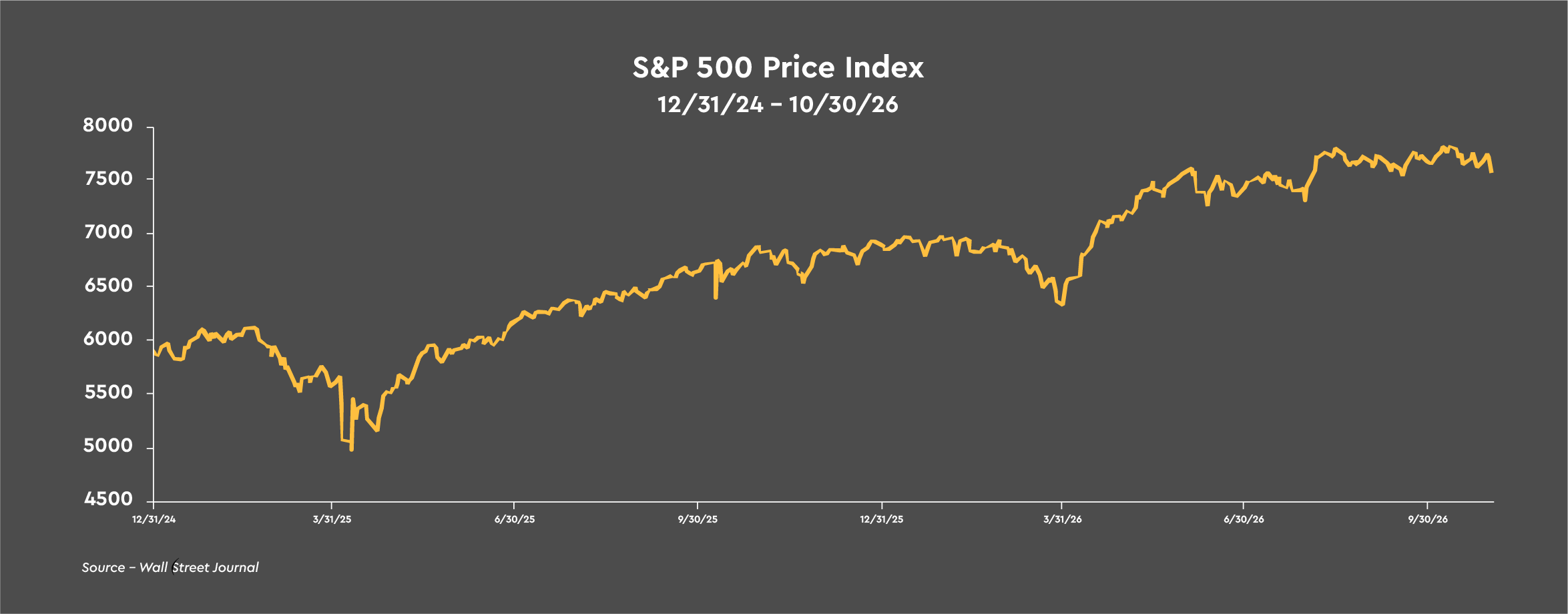
Operating earnings grew 22.1% on a year-over-year basis in 1Q 2026 and a remarkable 32.4% in 2Q 2026. With 60% of the S&P 500 companies reporting, the earnings momentum appears to be intact with operating earnings projected to have grown 32.9% on a year-over-year basis in 3Q 2026 with operating margins expanding to 17.9% from 16.5% at year end 2025 and 15.4% at year end 2024, materially greater than the 8% to 9% profit margins of ten years ago.
The consensus forecast provided by FactSet is for operating earnings to grow 27.8% over the four quarters of 2026, compared to 12.3% and 12.9% in 2024 and 2025, respectively. Strong earnings growth continues the two year long trend of lowering the price-to-forward earnings ratio to 18.7x from 19.7x at year end 2025 and 21.4x two years ago.
Meanwhile, with technology companies carrying a price-to-forward earnings ratio of 19.0x currently compared to 30.6x two years ago, valuations seem reasonable. Investors have the opportunity to invest in some of the best and most profitable companies in Corporate America at valuations that rival the best levels since before the pandemic.
Generous Real Yields on Treasury Securities Draw Investor Interest
After being under persistent upward pressure since February 27 when the U.S. and Israel attacked Iran, Treasury yields spiked significantly higher during September. An acceleration in the pace of economic activity over the summer, the unrelenting growth in the national debt with the federal budget deficit hitting $1.99 trillion for FY 2026, the surge in borrowing by technology companies to finance the AI infrastructure buildout, and expectations for additional rate hikes by the Federal Reserve all contributed to the spike higher in Treasury yields.
We commented in the October 1 Investment Strategy Statement that Treasury securities were offering investors very attractive real, or inflation-adjusted, yields as the month unfolded. Ten-year real yields on Treasury securities were the highest in more than 24 years, while the real yield on two-year Treasury securities was unusually high for a shorter-term Treasury instrument that normally trades only moderately higher than the expected inflation rate over the two year term of the security.
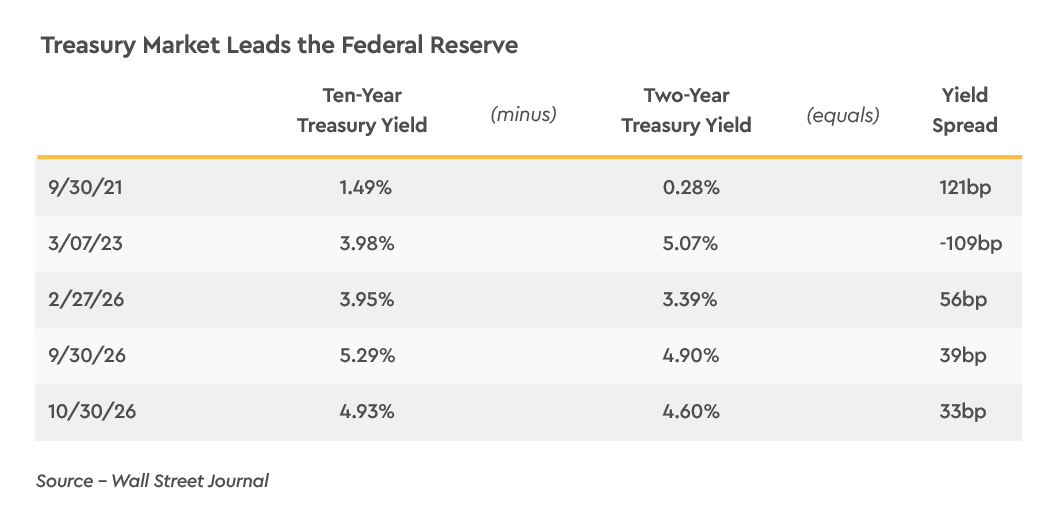
During October, two-year Treasury yields retraced just over half of their September rise, while ten-year Treasury yields gave back roughly two-thirds of the September jump, as the very attractive level of real yields attracted buyers. Helping to fuel the rally in Treasury prices was concern that the economy’s growth rate could downshift if the pace of the AI buildout slowed and high and rising energy costs weighed further on lower and moderate income households. Treasury securities also caught a bid from a flight-to-safety trade as the selloff in technology stocks gathered momentum over the course of the month.
The ten-year Treasury yield fell -36 basis points to 4.93% during October with the real yield falling -34 basis points to 2.58%, while the expected inflation rate dropped -2 basis points to 2.35%. While the ten-year real yield declined -34 basis points during October, it is still the highest inflation-adjusted ten-year Treasury yield since late 2008, offering investors an attractive entry point.
At the shorter end of the Treasury yield curve, the two-year Treasury yield fell -30 basis points to 4.6% by the end of October with the real yield falling -36 basis points to 2.05%, still representing a significant real yield on a two-year Treasury note. The inflation expectation on a two-year Treasury security ended October at 2.55%, which is only 4 basis points higher than on February 27 despite oil prices being $37 higher. Similarly, the 2.35% inflation expectation in the ten-year Treasury is only 11 basis points higher than before the start of the Iran war.