

Beyond the AI Boom: A Market in Transition
11/4/2026 (Updated: 11/5/2026) - By Joseph Keating - On Point Investment Strategy Statement | SouthState Wealth
Investors pulled back from stocks connected to the AI buildout and piled into almost everything else last month, from Treasury securities to large and small companies that are more removed from the AI cohort. Increasingly, the main concern with AI is not about the technology anymore, it is about how the capital markets fund the massive capital needs in short order -- particularly in light of the massive federal budget deficits that need to be financed -- as the race to remain ahead of competitors and China brings the demand for additional compute power to the forefront.
Technology Stocks Had Rough October as AI Concerns Build
Last month investors again revisited the big questions about the AI future. While AI will undoubtedly have a profound effect on the economy and the business models of companies across the economy, it remains uncertain exactly what those effects will be, which companies will profit from them, and to what extent. A transformative technology is not necessarily a profitable investment for all participants. Investors feared demand for AI compute power may not be enough to justify the amount of capital companies are borrowing to build their networks.
The internet fundamentally changed economies across the globe and the way of life for the world’s population, yet many investors lost money during its initial buildout. AI could produce a similar mismatch between the ultimate winners that benefit from the technology and some of those companies that are funding and taking part in the buildout. The ultimate return on investment for the companies involved in the AI buildout is unknown, but the greater the investment, the greater the required return, with no guarantee that it will be realized. There will be winners and losers; however, they will only be revealed with time.

For the AI infrastructure buildout to work out for investors long term, the extraordinary, but temporary, capital spending-related profits need to transition over time to sustainable AI profits derived from the users of the technology. The datacenter buildout is generating massive revenue and profits for manufacturers of semiconductor chips, servers, storage systems, switches and routers, firewalls and security gear, cooling equipment, fiber optics and cabling, battery systems and backup generators, turbines, and a host of other supplies.
The buildout will not last forever, however, with industry experts saying it could last another four to six years before spending on maintenance, repair, and upgrades will take over. This transition is well understood, and the issue is how long the AI capital spending-related profits can stay at current levels, not whether they can remain in place. Stock prices of AI-related companies reflect this, as share price gains have lagged the gains in earnings, leading to a drop in price-to-forward earnings ratios. Investors typically do not pay up for peak earnings, or earnings that are building toward a peak, and this process has naturally de-risked the current share prices of many AI-related companies.
Sustainable AI profits will be generated by companies finding worthwhile uses for the technology that increase productivity and lead to the discovery of scientific, healthcare, and other breakthroughs such that companies are willing to pay the full cost of developing and using the technology. The good news from prior capital spending booms in that they mostly delivered as much or more than what was expected with more efficient production and huge benefits for economic growth and society.
The bad news for some investors was that it may have taken too long for the benefits of the new technology to be realized, profits could have been smaller or come later than hoped, or competition caused excess profits to flow to the users of the new technology rather than its developers or owners. These are the issues facing investors today as they search for the long-term winners from the development of the AI technology.
Investors were also concerned about higher borrowing costs slowing the historic buildout in AI infrastructure which has become the major driver of the economy’s growth rate over the past eighteen months or so. There is also growing risk that certain companies involved in the AI buildout will not have access to the credit markets unless they have vibrant and very profitable core businesses that are unrelated to the data center buildout.
That means the so-called “neocloud” companies -- specialized cloud infrastructure providers that rent out computing power to train and run AI models -- could face intense revenue pressure if AI developer demand or access to capital dries up, as they do not have independent revenue sources. In that event, certain neocloud companies could be unable to continue the buildout they have been involved in, likely leading to losses and consolidation in the sector.
These concerns over access to the credit markets add pressure to a sector already facing investor concerns about debt-fueled expansion and whether the AI infrastructure buildout will generate the required returns to justify the investment. While financing conditions became less favorable and quite a bit more uncertain in recent months, underlying demand for computing power remained extremely strong, however.
While a drop in Treasury yields from mid-month peaks points to some capital being diverted to the very generous real yields that fixed income securities were offering last month during the pullback in technology stocks, investors did not leave the equity market en masse and instead largely rotated within the equity market as evidenced by the majority of sectors posting gains, while the technology and communications sectors posted losses.
The yield on the ten-year Treasury note fell below 5% for the first time in more than a month over the back half of October. It is interesting that Treasury yields fell despite oil prices surpassing $100 a barrel. Oil prices rose from their early October lows below $90 a barrel as fresh attacks from Iran-backed Houthi militants against Saudi Arabian oil installations raised new fears over an oil supply squeeze, along with attacks on airports in Saudi Arabia and other non-military targets.
Investors pulled back from stocks connected to the AI buildout and piled into almost everything else last month, from Treasury securities to large and small companies that are more removed from the AI cohort. Increasingly, the main concern with AI is not about the technology anymore, it is about how the capital markets fund the massive capital needs in short order -- particularly in light of the massive federal budget deficits that need to be financed -- as the race to remain ahead of competitors and China brings the demand for additional compute power to the forefront.
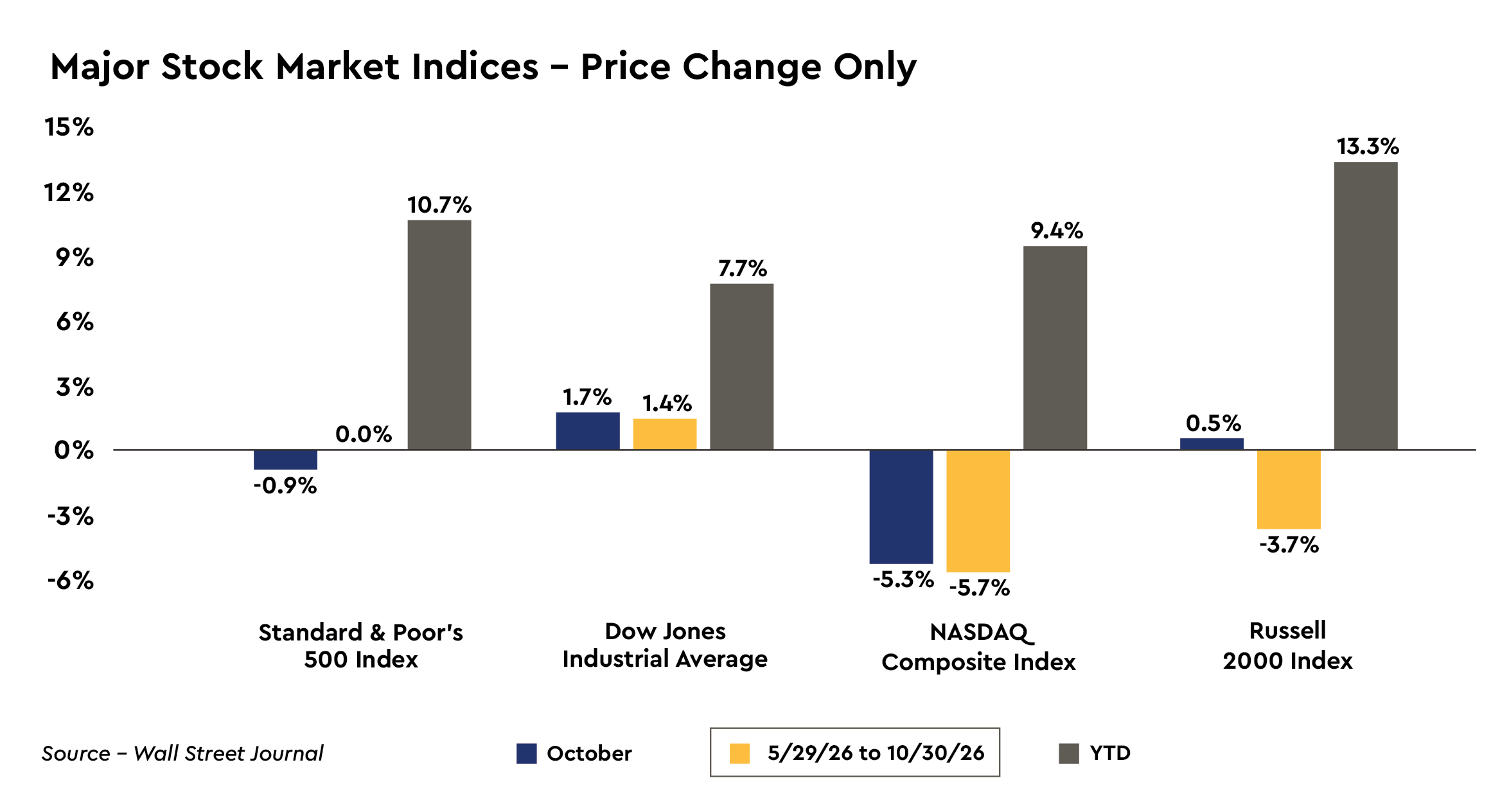
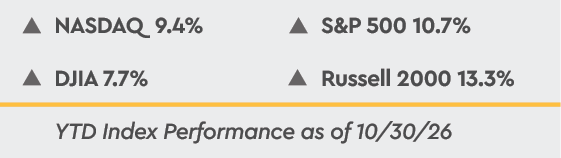
The ongoing uncertainty about the AI future showed up in the returns on the major market measures for October. The technology-heavy NASDAQ Composite led the way lower with a drop of -5.3%, while the S&P 500 fell -0.9%. The DJIA has the least exposure to the AI buildout, and investors turned to several of its member stocks last month. The index gained 1.7%, while the Russell 2000 Index of small company stocks posted a modest gain of 0.5%. For the first ten months of 2026, the major market measures are positive, recording gains of 7.7% to 13.3%, with the Russell 2000 leading the way.
Federal Reserve Leaves Rates Unchanged, Wants Additional Information
The FOMC Committee decided to leave the target range for the federal funds rate unchanged at the October 27-28 FOMC meeting, citing in the policy statement that “The accumulation of more information will help the Committee determine the policy stance appropriate to ensure a timely return of inflation to the Committee’s 2 percent goal.” The vote was 10 to 2 with Governor Lisa Cook and Cleveland Federal Reserve Bank President Beth Hammack preferring to raise rates by 25 basis points. The policy statement described the economy as “strong,” an upgrade from “solid” in the previous policy statement, and Chairman Kevin Warsh referred to inflation as too high.
The October FOMC meeting was really all about the December FOMC meeting and the difficult task the Federal Reserve faces when inflationary pressures in the economy are largely being driven by cost-push inflationary pressures arising from supply shocks from oil and tariffs, not demand-pull inflationary pressures arising from wage pressures. The futures market for the federal funds rate has the probability of a rate hike priced at 75% for the December 8-9 FOMC meeting, likely reflecting the high level of oil prices since early October. The Federal Reserve can do nothing to address supply shocks to fight inflationary pressures; it can only try to suppress overall aggregate demand in the economy by raising rates.
The most recent reading on average hourly earnings, or wages, was a 3.0% year-over-year increase. Considering that labor productivity has averaged 2.0% since 2000, a 3.0% pace of wage gains is consistent with a core inflation rate of 2.0% or less. The Federal Reserve’s upbeat assessment of the economy was validated the next morning when it was reported the economy grew 3.4% in 3Q 2026.
The data clearly showed that the main source of growth in the economy is the AI infrastructure buildout. In 3Q 2026, outlays for high tech equipment and intellectual property products -- which accounted for 12.9% of the economy a year ago -- contributed 56% of the economy’s quarterly growth rate in 3Q 2026 and 72% of its year-over-year growth rate. While the AI buildout was not the totality of the outlays for high tech equipment, it clearly was the majority of it.
While upper income households continue to spend, as evident in the 3.8% gain in consumer spending in 3Q 2026, lower to moderate income households are struggling to make ends meet as high refined crude product prices are showing up at the pump and in the prices of goods sold across the economy, especially for necessities, including food. The decline in the personal savings rate to 3.8% in September 2026 from 6.2% in April 2025 prior to the hike in tariffs reflects the squeeze on households from higher inflation.
The housing market remains frozen, and light motor vehicle sales have averaged 15.5 million over the past five years compared to 17.0 million prior to the pandemic. This puts the Federal Reserve in the precarious position of slowing the economy to fight inflationary pressures that are largely out of their control, when the possibility of the economy’s growth rate slowing a bit over the next year to a pace closer to 2% is likely, given the high degree of geopolitical uncertainty and the waning impact of the tax and spending bill signed into law in July 2025.
The biggest news from the meeting was Chairman Warsh announcing that while the FOMC Committee will continue to meet eight times a year in 2027 and in 2028, one of the meetings in 2027 and two of the meetings in 2028 will focus exclusively on broad monetary policy strategy. The remainder of the FOMC meetings will remain centered on setting monetary policy.
Looking forward, with inflation being reported at 3.7% over the past year for both the PCE price index and the CPI and being above the central bank’s 2% target for five and a half years, we think the Federal Reserve is likely to raise rates at the December 8-9 FOMC meeting as it risks losing credibility with investors of it does not. The FOMC Committee has boldly closed the last four policy statements with “The Committee will deliver price stability,” and the markets appropriately expect a certain amount of action toward achieving that goal.
Could the Iran Conflict Be Reaching a Tipping Point?
Oil is reportedly moving through the Strait of Hormuz with most Gulf nation crude exports well above their March/April lows, and in fact on certain days exceeding their pre-war levels. Iranian volumes are the exception as crude exports from Iran are virtually nonexistent. This outcome has kept global oil prices from spiking further while squeezing the Iranian regime. From the little information that trickles out of Iran, it appears the Iranian economy is in free fall with inflation near 100% as Iran’s currency is basically worthless with widespread shortages of basic necessities, fuel, and foodstuffs.
With Iran losing $100 to $200 million a day in oil revenue and the extremely harsh economic sanctions that were put in place in August, the regime cannot pay government workers, military personnel, and importantly, the members of the IRGC, the powerful political, military, and economic force that dominates Iran, defends the regime, and coordinates Iran’s war effort. It is unclear how much longer the Iranian regime can hold on, but its staying power does not look very good as economics aways wins out in the end. In our view, caution and patience should guide U.S. policy on Iran, as it appears time is on the side of the U.S.
Booming Earnings versus Mounting Challenges to the Outlook for Stock Prices
Investors are facing a highly volatile period of time due to uncertainty over oil prices, myriad risks from AI-related technology companies, massive federal budget deficits that are weighing on the credit markets facing outsized AI buildout credit demands, uncertainty over the outlook for fiscal policy and regulatory efforts in the aftermath of the midterm elections, and Federal Reserve policy over the next 7-8 months with inflation above the central bank’s 2% target.
While there is plenty to challenge the stock market in the near term, the outlook for common stocks ultimately comes down to the outlook for the economy and earnings. The economy is set to enter 2027 with solid forward momentum, although the economy’s growth rate should slow from the strong growth rate of 3.4% in 3Q 2026. Meanwhile, the earnings trajectory is nothing short of spectacular with profit margins at record high levels.
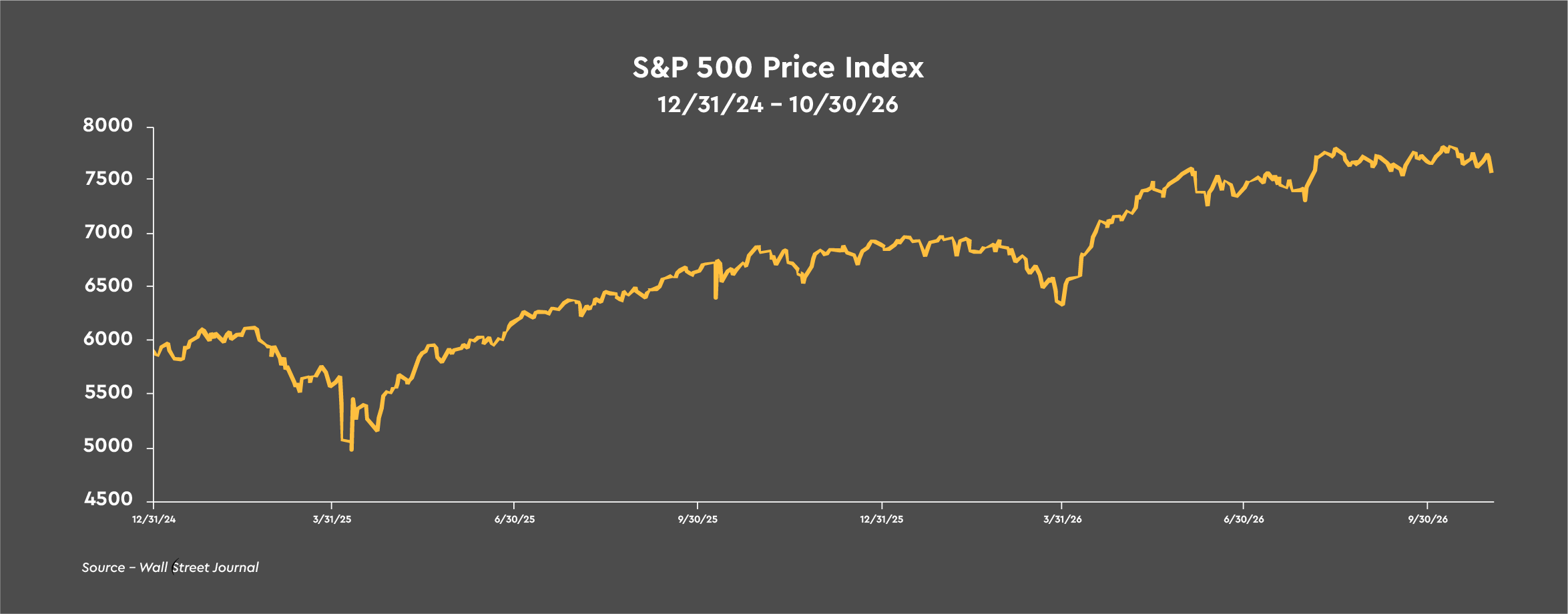
Operating earnings grew 22.1% on a year-over-year basis in 1Q 2026 and a remarkable 32.4% in 2Q 2026. With 60% of the S&P 500 companies reporting, the earnings momentum appears to be intact with operating earnings projected to have grown 32.9% on a year-over-year basis in 3Q 2026 with operating margins expanding to 17.9% from 16.5% at year end 2025 and 15.4% at year end 2024, materially greater than the 8% to 9% profit margins of ten years ago.
The consensus forecast provided by FactSet is for operating earnings to grow 27.8% over the four quarters of 2026, compared to 12.3% and 12.9% in 2024 and 2025, respectively. Strong earnings growth continues the two year long trend of lowering the price-to-forward earnings ratio to 18.7x from 19.7x at year end 2025 and 21.4x two years ago.
Meanwhile, with technology companies carrying a price-to-forward earnings ratio of 19.0x currently compared to 30.6x two years ago, valuations seem reasonable. Investors have the opportunity to invest in some of the best and most profitable companies in Corporate America at valuations that rival the best levels since before the pandemic.
Generous Real Yields on Treasury Securities Draw Investor Interest
After being under persistent upward pressure since February 27 when the U.S. and Israel attacked Iran, Treasury yields spiked significantly higher during September. An acceleration in the pace of economic activity over the summer, the unrelenting growth in the national debt with the federal budget deficit hitting $1.99 trillion for FY 2026, the surge in borrowing by technology companies to finance the AI infrastructure buildout, and expectations for additional rate hikes by the Federal Reserve all contributed to the spike higher in Treasury yields.
We commented in the October 1 Investment Strategy Statement that Treasury securities were offering investors very attractive real, or inflation-adjusted, yields as the month unfolded. Ten-year real yields on Treasury securities were the highest in more than 24 years, while the real yield on two-year Treasury securities was unusually high for a shorter-term Treasury instrument that normally trades only moderately higher than the expected inflation rate over the two year term of the security.
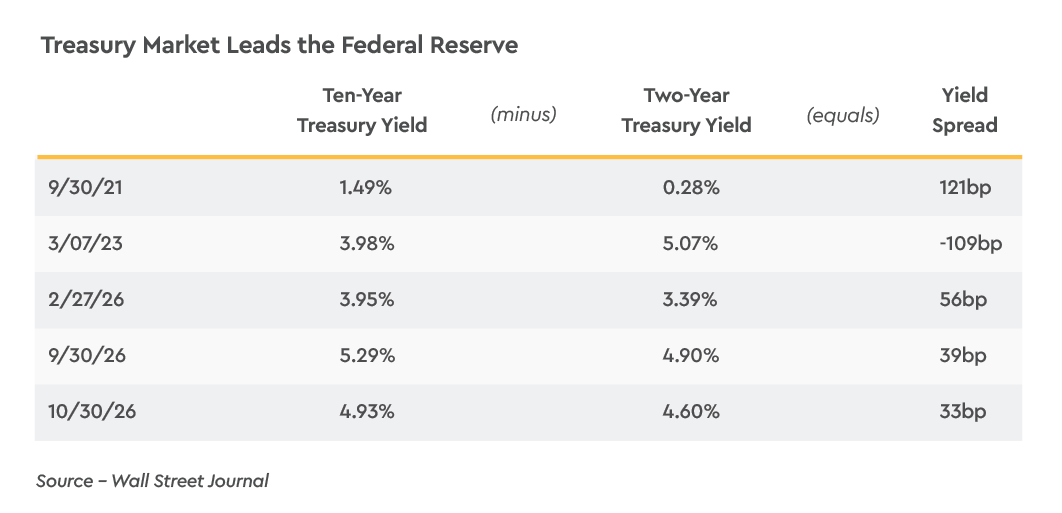
During October, two-year Treasury yields retraced just over half of their September rise, while ten-year Treasury yields gave back roughly two-thirds of the September jump, as the very attractive level of real yields attracted buyers. Helping to fuel the rally in Treasury prices was concern that the economy’s growth rate could downshift if the pace of the AI buildout slowed and high and rising energy costs weighed further on lower and moderate income households. Treasury securities also caught a bid from a flight-to-safety trade as the selloff in technology stocks gathered momentum over the course of the month.
The ten-year Treasury yield fell -36 basis points to 4.93% during October with the real yield falling -34 basis points to 2.58%, while the expected inflation rate dropped -2 basis points to 2.35%. While the ten-year real yield declined -34 basis points during October, it is still the highest inflation-adjusted ten-year Treasury yield since late 2008, offering investors an attractive entry point.
At the shorter end of the Treasury yield curve, the two-year Treasury yield fell -30 basis points to 4.6% by the end of October with the real yield falling -36 basis points to 2.05%, still representing a significant real yield on a two-year Treasury note. The inflation expectation on a two-year Treasury security ended October at 2.55%, which is only 4 basis points higher than on February 27 despite oil prices being $37 higher. Similarly, the 2.35% inflation expectation in the ten-year Treasury is only 11 basis points higher than before the start of the Iran war.
The main driver of Treasury yields over the next few months will likely be how the Iran war plays out and its impact on oil prices. Real yields should remain higher for longer as we continue to expect an elongated economic cycle with strong demand for credit staying in place from technology companies involved in the data center buildout and the federal government which continues to show little interest in getting the outlandish federal budget deficits under control.
Shorter term inflation expectations will almost immediately be impacted by a significant change in oil prices which will flow through to two-year Treasury yields which are very responsive to near-term inflation pressures and expectations for monetary policy. Ten-year Treasury yields will also respond to oil prices, but not to the same extent as the maturity date of the security is further out and the yield more closely tracks the longer-term trend in nominal GDP.
Given our well-documented concerns over the size of the federal budget deficit and the ballooning national debt that is currently carrying an interest expense greater than $1 trillion per year, we recommend intermediate-term securities in the five-to-seven-year range rather than longer maturity securities. Adding corporate securities to the mix will increase the real return on the fixed income portfolio. That medium term exposure can be bar belled with holdings at the shorter end of the Treasury yield curve which is still elevated and providing higher real yields than usual due to the heavy issuance of Treasury bills to finance the federal budget deficit and expectations of additional rate hikes.