Bull Market Remains Intact as Earnings Momentum Builds
9/3/2026 - By Joseph Keating - On Point Investment Strategy Statement | SouthState Wealth

In our view, the bull market in common stocks remains intact and appears poised to continue into 2027, propelled by strong earnings momentum and a very healthy decline in valuations as earnings have grown at a much faster pace than stock prices have risen since the second half of 2025.
Common Stock Prices Post Gains During August
After largely trading sideways for two months, a series of events boosted investor confidence and stock prices in early August. As July ended, an AI-focused hedge fund was forced to unwind its highly leveraged, concentrated portfolio after suffering steep losses. The forced liquidation, along with selling from other investors who had copied the fund’s trades, flooded the market with shares of AI infrastructure companies to be sold. The collapse of the narrowly focused technology hedge fund removed a major source of indiscriminate selling pressure, setting the stage for a rebound in technology stocks which, on average, posted very strong earnings in 2Q 2026.
President Trump then backed off his threats of new attacks on Iran that he said would be the equivalent to World War II as mediators from Egypt, Pakistan, and Qatar made fresh progress on a plan to open the Strait of Hormuz and Gulf State leaders pressed the president to re-engage in dialogue with Tehran. Treasury Secretary Bessent also stated in a television interview that the U.S. and Iran could reach a deal within days to resolve the dispute over the strait, sending oil prices lower. What appeared to be a cooling of geopolitical tensions was received positively by investors.
Turning to the economy, the labor market lost -23,000 jobs in July and revisions to May and June payrolls showed the economy added -103,000 fewer jobs in those two months than originally reported. The Labor Department data now show the economy added 61,000 jobs a month so far in 2026, historically a modest pace of employment growth, however, much better than the -9,000 jobs a month the labor market lost over the final seven months of 2025 as businesses adjusted to the rise in tariffs. The somewhat slow pace of job gains this year largely reflects the immigration crackdown limiting the supply of foreign born workers entering the workforce and the demographic impact of the baby boomer generation moving into retirement.
The soft July jobs report and the downward revisions to prior months prompted investors to temporarily scale back expectations for an interest rate hike in September. The inflation reports for July also supported the Federal Reserve remaining on hold with the core CPI higher by 2.5% over the past year, down from a 3.1% gain in the twelve months ending July 2025.
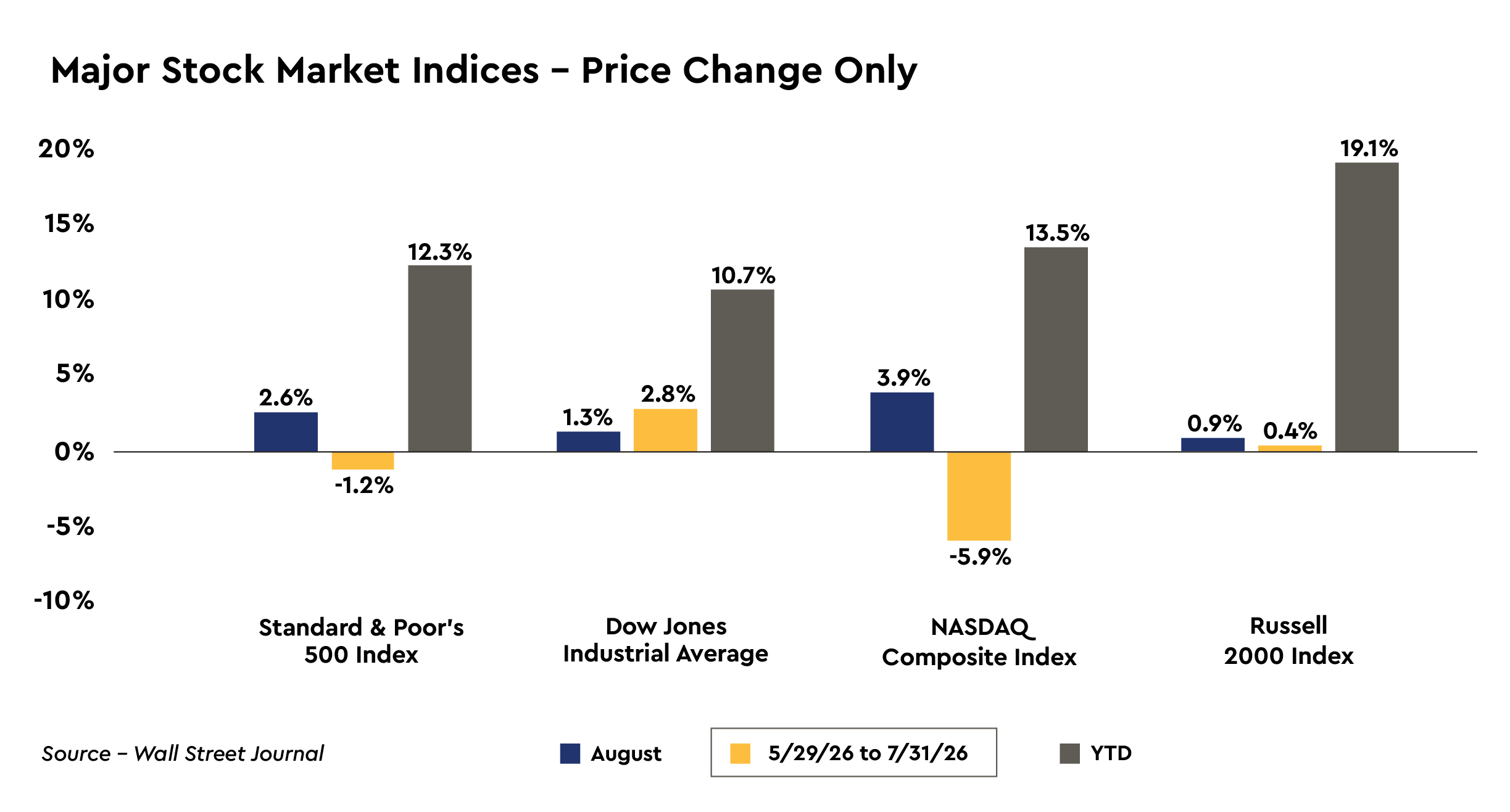
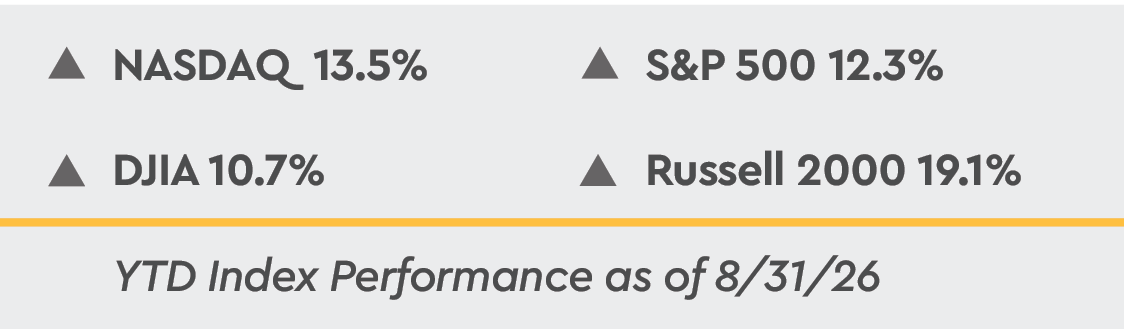
Stock prices ran into some turbulence mid-month, which lasted into month end, as the continuing conflict in the Middle East, still elevated oil prices, persistently higher Treasury yields, and hawkish remarks by Federal Reserve Chairman Kevin Warsh last week weighed on investor sentiment. For the full month of August, the major stock market measures posted solid gains of 0.9% to 3.9% with the NASDAQ Composite leading the way after declining -5.9% during June and July. For the first eight months of 2026, the major stock market measures are higher by 10.7% to 19.1% with the Russell 2000 continuing to lead the way.

Kevin Warsh Delivered a Hawkish Keynote Address at Jackson Hole
Federal Reserve chairs have generally used their presentations at the central bank’s annual Jackson Hole Economic Symposium to set expectations about monetary policy. While Kevin Warsh avoided providing forward guidance and any other hints regarding the path of monetary policy, he did provide a fairly clear view of his assessment of the economy. Chairman Warsh’s address was clearly hawkish, citing inflation as the main risk to the central bank’s dual mandate and stating that financial conditions were not restrictive.
Mr. Warsh said that “We must be confident that underlying inflation is moving to our objective, clearly and at sufficient speed… otherwise we have work to do.” He added that this summer’s encouraging inflation readings do not indicate “meaningful” improvement on underlying trends by noting the breadth of price increases across the economy. Roughly half the items in the central bank’s preferred inflation basket are rising faster than 3%, which compares unfavorably to about one third in the two decades prior to the pandemic.
The body of Chairman Warsh’s comments set a fairly high bar for the central bank standing pat at the September 15-16 FOMC meeting as he changed the presumption from the central bank holding rates steady unless the data made a definitive case to change policy, to raising rates unless the data suggest it is not necessary. The market raised the probability of a rate hike this month to 64% from 35% before the speech.
Three things are keeping the probability of a September rate hike from moving even higher. One is that the August inflation readings on the CPI and the PPI will be released before the meeting. Cool readings could keep the Federal Reserve on hold. Another is that Mr. Warsh acknowledged that the market derived inflation expectations remain stable, running only slightly above 2%. Finally, Chairman Warsh concluded his remarks by stating, “I stand here today committed to a discipline, not to a decision,” indicating he has an open mind on a rate decision this month, despite the hawkish tone of his remarks.
U.S. Imposes Secondary Sanctions on Iran
For the past six months, Iran’s ability to disrupt shipping traffic through the Strait of Hormuz by launching intermittent missile and drone attacks gave it powerful leverage, allowing Tehran to keep oil prices elevated, leading to global economic disruptions and higher inflation. The Iranian regime believes the longer the standoff persists, the more pressure shifts back onto the Trump administration with the midterm elections 64 days away, leading the regime to believe it has time on its side, leading it to expand its demands for reopening the strait.
After nearly two weeks of heavy airstrikes during July following the collapse of the deal agreed to in the memorandum of understanding, or MOU, signed in June, President Trump shifted his strategy last month to back off military action in favor of tightening economic pressures on the Iranian regime. The belief is that the combination of heightened economic sanctions and the U.S. Navy’s blockade of Iran’s ports will push Iran’s heavily damaged economy into free fall and eventually soften Iran’s hard line negotiating stance, and possibly even lead to regime change.
The Trump administration significantly increased the severity of the economic sanctions last week when Treasury Secretary Bessent announced a plan to sever virtually every economic lifeline that sustains the Iranian regime by threatening to impose secondary sanctions on any country that “facilitates transactions and are part of the ecosystem that turns Iranian oil into money.” Mr. Bessent said that “Any entity that facilitates money laundering on behalf of Iran will be removed from the U.S. dollar system.” He went on to say that the promised sanctions had not yet been imposed, rather the U.S. would start by sending timelines to individual countries to “shut down activities we have identified.” Secretary Bessent referred to the secondary sanctions as “Operation Economic Outcast.”
The key question of the conflict for some time has been which side blinks first under the economic pressures generated by high global oil prices, the U.S. naval blockade, and heightened economic sanctions on Iran that now include secondary sanctions on the so called “enablers” that continue to trade with Iran and are keeping the Islamic Republic afloat.
The Iranian regime, which is increasingly dominated by hard-line leaders of the IRGC, must weigh the cost of enduring the severe economic pain of the blockade and ever more draconian economic sanctions to achieve its military and geopolitical objectives and extract major concessions from Washington versus the threat that the extreme hardship on the economy and Iranian citizens could lead to attempts to overthrow the regime.
Our biggest concern in July following the signing of the MOU with Iran was how much negotiating leverage the U.S. had given up to begin negotiations with Iran to end the conflict. The U.S. has now taken back the leverage that came with the blockade of Iran’s ports and has only increased that leverage by launching an economic onslaught against Iran’s financial connections around the globe. Time will tell which party has the effective leverage to turn the future negotiations to permanently end the conflict in their favor. For the time being, we can only monitor the effectiveness of the secondary sanctions and the broader security environment in the Strait of Hormuz and the actual traffic going through it.
One consequence of Iran centering its strategy on controlling the Strait of Hormuz and President Trump doubling down on economic pressure as the preferred strategy is that no end to the current standoff is in sight. While the Trump administration will need to endure the political consequences of extending the conflict and U.S. consumers will continue to pay higher prices for gasoline, the U.S. should be able to withstand the economic fallout much better than Iran is able to withstand the economic sanctions designed to isolate its economy, losing $400 to $500 million a day in oil revenue, soaring inflation as Iran’s currency has fallen -72% over the past year against the U.S. dollar, including another -11% drop over the past two weeks, and widespread shortages of basic necessities, fuel, and foodstuffs.
Earnings Continue to Carry the Day for Stock Prices
Our view remains that the economy is in the midst of an elongated cycle, however, the disruptive tariff policies of 2025 and the jump in oil prices this year from the now six month long conflict in Iran have resulted in a mid-cycle slowdown that has proven to have some legs. The status of the various sectors of the economy ranges from the housing sector that remains frozen in place due to ongoing very poor affordability conditions to expenditures for high tech equipment and intellectual property that are red hot due to the very aggressive data center buildout, while consumer spending and the labor market fall somewhere in between.
Consumer outlays are bifurcated with strong expenditures at wealthy and upper income households while less fortunate and lower to moderate income households are struggling to make ends meet. The labor market appears stable in a 15 month or so slow to hire, but also slow to fire, steady state. The economy should continue to grow at a pace near 2%, right in line with its long run growth rate since 1970, and with corporate credit yield spreads remaining very tight, we see little risk of recession for the foreseeable future.
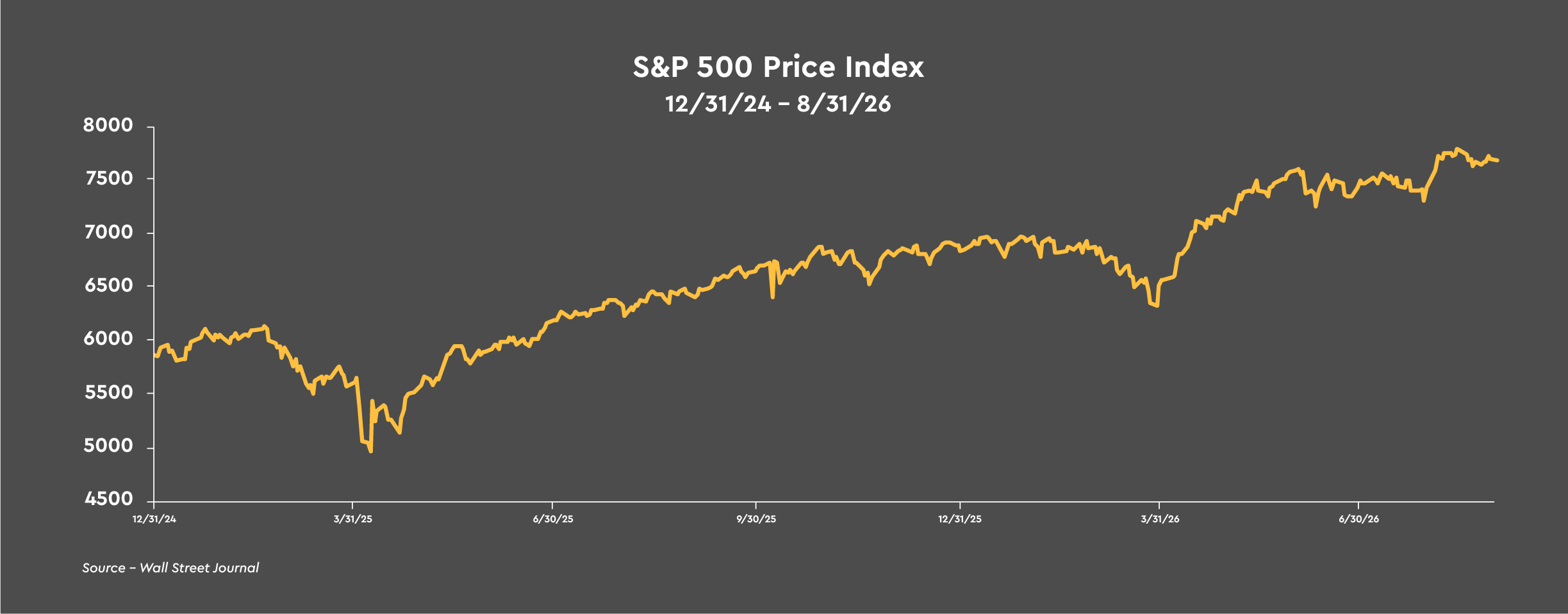
In our view, the bull market in common stocks remains intact and appears poised to continue into 2027 propelled by strong earnings momentum and a very healthy decline in valuations as earnings have grown at a much faster pace than stock prices have risen since the second half of 2025. Consider that in late October the price-to-forward operating earnings ratio on the S&P 500 reached 23.4x. Despite the S&P 500 gaining another 12.4% from the end of October to the end of August, the forward looking P/E ratio has dropped to 20.2x as earnings have been nothing short of spectacular.
After growing 15.6% for full year 2025, operating earnings for the S&P 500 companies grew 21.7% on a year-over-year basis in 1Q 2026 and with 97% of the S&P 500 companies reporting, 2Q 2026 operating earnings are projected to have grown an amazing 31.7% compared to 2Q 2025. The consensus forecast provided by FactSet is for operating earnings to grow 26.3% over the four quarters of 2026, another significant advance.
With 86% of S&P 500 companies beating earnings estimates last quarter and net operating profit margins for 2Q 2026 estimated at 17.1%, higher than the year ago profit margin of 16% and materially greater than the 8% to 9% profit margin of ten years ago, the two year long period of S&P 500 companies growing their operating earnings at a pace above the 7.25% long run earnings growth rate since the end of WWII should remain intact. Earnings are forecast to grow at a 12% to 13% pace in calendar year 2027, a slower pace of growth than in 2026, but still materially above the long run growth rate.
There remain two major risks to the outlook for stock prices. One is the ongoing conflict in Iran which is keeping oil prices elevated and placing upward pressure on fixed income yields in the near term from elevated inflation readings resulting from higher energy costs. The longer term risk is from the seemingly out of control deficit spending in the U.S., but also in many industrialized nations across the globe, which is also placing upward pressure on fixed income yields. Investors appear to be anticipating that the Iranian conflict will end in reasonably short order due to the economic hardships it is bringing to Iran and the global economy, but an end to the fiscal imbalances is not currently evident, but will inevitably need to be dealt with in one way or another. More on this topic to follow.
Federal Government and AI-Related Borrowing Are Dominating the Debt Markets
The yields on two-year and ten-year Treasury securities have risen 96 and 81 basis points, respectively, since February 27 before the U.S. and Israel attacked Iran, sending oil prices sharply higher and boosting inflation pressures. It would be natural to expect that the rise in Treasury yields would be primarily the result of higher inflation expectations rather than an increase in real yields.
However, the two year inflation expectation embodied in Treasury securities has actually fallen 18 basis points since the end of February, while the real yield has risen 114 basis points. In the ten year portion of the curve, the inflation expectation has only risen 11 basis points, while the real yield has risen 70 basis points. What is behind this somewhat surprising turn of events? The culprits are the federal government and AI-related borrowing placing heavy demands on the debt markets.
Consider that today the debt markets are dominated by one large and two very large borrowers. The large borrower is state and local governments, which tap the debt market for between $500 billion and $600 billion annually. The federal government funded budget deficits on the order of $1.7 trillion to 1.8 trillion over the past three years. The FY 2026 federal budget deficit is projected to be $2.1 trillion. Finally, corporate debt issuance was $2.2 trillion in 2025, with AI-related infrastructure borrowing of approximately $115 billion. The data center buildout borrowing is expected to exceed $500 billion in both 2026 and 2027.
The federal government budget deficit averaged $591 billion in the seven years prior to the pandemic and AI-related corporate borrowing was essentially zero three to four years ago. The explosion in the federal budget deficit during and in the years following the pandemic and the data center buildout are a classic example of the current and expected supply of new securities crowding out other borrowers, principally home buyers, with the market allocating capital by raising the required yield.
The real yield on two-year Treasury notes rising more than the two-year Treasury yield since February 27 reflects the Treasury Department relying more than usual on funding the budget deficit at the shorter end of the yield curve to manage the supply of longer dated Treasury securities. Investors have shown strong demand for the debt being issued by the large and very profitable technology companies that are engaged in the data center buildout, but have shied away from what appears to be a never ending supply of Treasury debt. The outcome is upward pressure on yields, in general, with corporate yield spreads remaining very narrow by historical standards.
The Buildup in the National Debt Is Unsustainable
Following the thirty-year Treasury bond yield hitting 5.31% on August 17, its highest level since 2004, the Treasury Department announced on August 19 that it would double the size of its regularly scheduled $2 billion repurchase of off-the-run Treasury securities at the long end of the Treasury yield curve. The Treasury bond buyback program was launched in 2024 to support trading in older, less liquid Treasury securities. Treasury Secretary Bessent pointed to the level of bond yields as the reason for the proposed additional bond purchases, asserting that they did not reflect underlying fundamentals. Treasury yields fell immediately, only to round-trip the following day back to where they started.
The Treasury Department cannot buy its way out of ballooning federal budget deficits that are running near 6% of nominal gross domestic product, an unprecedented level when the economy is growing and there is no national emergency, with a slightly expanded liquidity tool aimed at yield management. The debt markets have been pricing the unprecedented amount of new issuance, inflation running between 3% and 4% and above the central bank’s 2% target for five years, an economy at full employment, the national debt more than doubling in ten years, reaching $40 trillion, and annual net interest expense on the national debt approaching $1 trillion, about 3.2% of nominal GDP on its own, and more than is spent on national defense.
The bond market has started the process of forcing the electorate and our elected officials in the federal government to address entitlement spending. The alarming reality is that the federal government is saddling Americans and our future generations with an enormous debt burden. The completely unsustainable buildup in the national debt will inevitably lead to higher taxes and/or lower entitlement benefits.
Hopefully, the end of the story will not include significant damage to the economy through much higher Treasury yields -- which would only exacerbate the federal budget deficit in the short run -- if the bond market is forced to take care of this matter on its terms. Out of control federal budget deficits and the ballooning national debt are subjects that require a serious adult debate about how to resolve the ticking time bomb of the national debt. It was only four election cycles ago and trillions of dollars in the national debt that Mitt Romney and Paul Ryan were campaigning in front of a national debt clock. Is it time for that campaign tactic to return?
Treasury Yields Rose Modestly during August
We mentioned in last month’s Investment Strategy Statement that the level of real yields on ten-year Treasury notes had reached its highest level since June 2006 at 2.47%, while two-year real yields hit 2.11%, a very generous real yield on fairly short dated Treasury debt. Those real yields appear to have attracted buyers during August, despite Treasury yields rising slightly on the month.
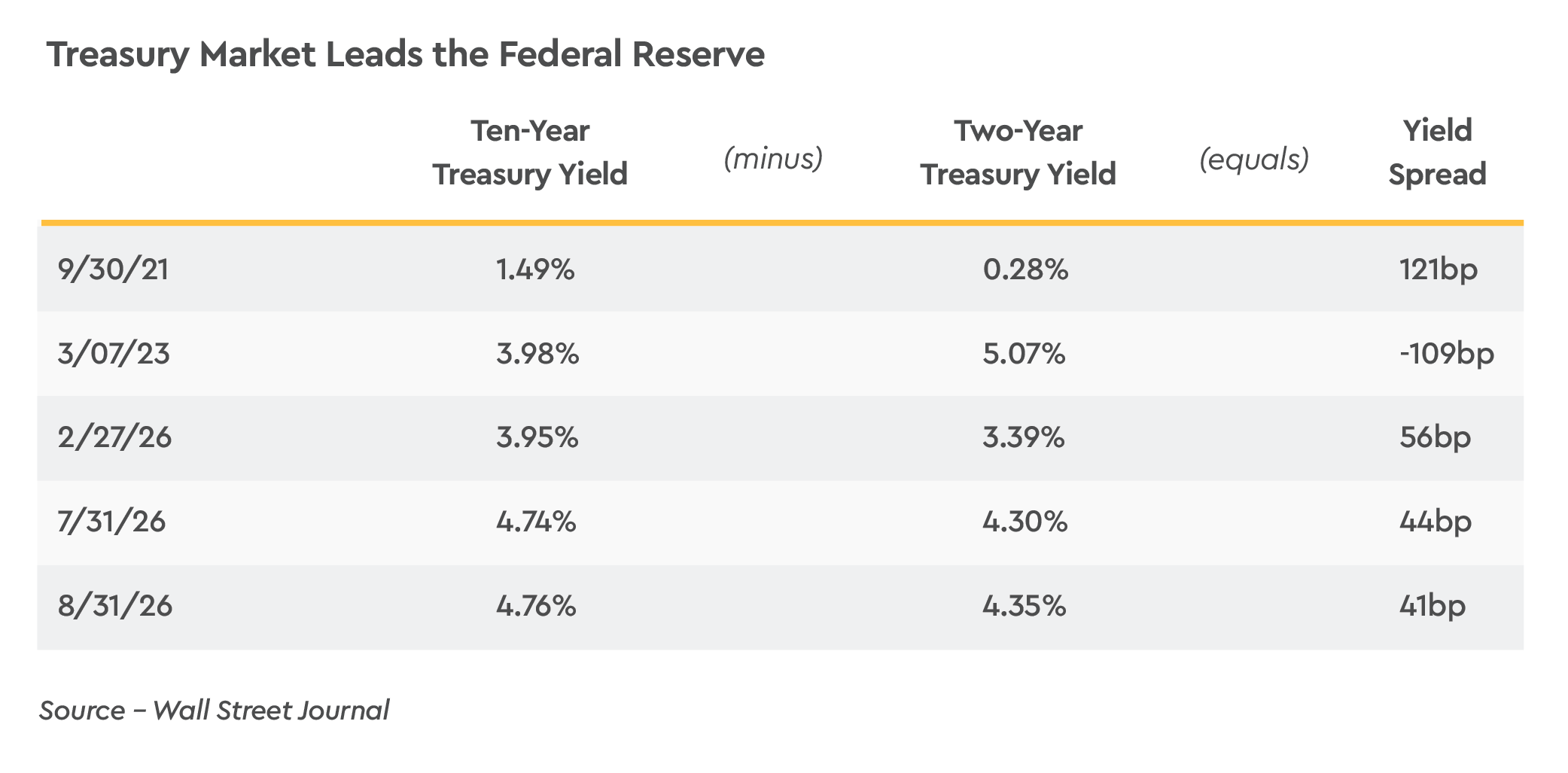
At the shorter end of the yield curve, the two-year Treasury yield rose 5 basis points to 4.35% from 4.30% at the end of July, with the real yield falling -12 basis points to 1.99%, while the two-year inflation expectation rose 17 basis points to 2.36%, likely due to the elevated level of oil prices.
The yield on ten-year Treasury securities rose a modest 2 basis points to 4.76% from 4.74% at the end of July, with the real yield falling -3 basis points to 2.44%. The ten year inflation outlook rose 5 basis points to 2.32%, once again likely due to current and expected oil prices. The real yield on the ten-year Treasury note is still very attractive on an historical basis, as is the 1.99% real yield on the two-year Treasury note.
Given our well documented concerns over the size of the federal budget deficit and the ballooning national debt that is currently carrying an interest expense of $1 trillion per year, we recommend intermediate term securities in the five to seven year range rather than longer maturity securities. Adding corporate securities to the mix will increase the real return on the fixed income portfolio. That medium term exposure can be barbelled with holdings at the shorter end of the Treasury yield curve which is still elevated due to the heavy issuance of Treasury bills to finance the federal budget deficit.