Earnings Remain Resilient as Investors Face Oil, Rates and AI Uncertainty
8/6/2026 (Updated: 8/24/2026) - By Joseph Keating - On Point Investment Strategy Statement | SouthState Wealth

The Iranian regime continues to weigh the cost of enduring the severe economic pain of the US blockade to achieve its military and geopolitical objectives and extract more concessions from Washington versus the threat that the extreme hardship on the domestic economy and Iranian citizens could lead to a repeat of the nationwide anti-government protests that erupted in January.
Oil Prices Rebound as Ceasefire Collapses
Renewed hostilities between the U.S. and Iran last month led to the withdrawal of a Treasury Department waiver that allowed the sale of Iranian oil in international markets and to a restart of the blockade of Iran’s ports, which reintroduced meaningful geopolitical risks across global financial markets and led to a rebound in oil prices just as they were approaching pre-Iran war levels. In last month’s Investment Strategy Statement we cautioned investors not to treat the signing of the memorandum of understanding, or MOU, on June 17 which contained a commitment by Iran to reopen the Strait of Hormuz and a halt to the U.S. blockade of Iranian ports as necessarily the end of the Iran conflict.
We warned that the signing of the MOU had to be viewed with a healthy level of skepticism that the Iranian regime would live up to its end of the agreement and whether the U.S. was in a position to reach all of its objectives at the negotiating table. Our biggest concern was how much negotiating leverage the U.S. had given up to get both sides to sign the MOU and begin negotiations to permanently end the conflict. Specifically, lifting the naval blockade and allowing Tehran to sell its oil again removed the key leverage points the U.S. had on its side in negotiations as they had squeezed Iran’s economy by severing its primary revenue source on the order of $400 to $500 million a day in oil revenue.
The loss of its primary source of hard currency sent Iran’s currency, the rial, to record lows against the U.S. dollar and inflation soaring to well over 50%, with the cost of food and other staples increasing on a weekly or daily basis according to the International Monetary Fund. With trade flows through maritime ports cut off, the inability to export forced many of Iran’s manufacturing facilities and factories to shut down.
Additionally, Iran’s monthslong internet blackout and severe restrictions on global networks severely damaged small businesses, online retailers, and freelance service providers who relied on global connectivity to reach clients and suppliers, resulting in significant declines in income for many Iranian households. Taken together, these disruptions led to widespread business closures and resulted in well over a million Iranians losing their employment.
Beyond the massive strains on the Iranian economy, the blockade severely hindered the regime’s finances, making it difficult to pay government workers, military personnel, and, importantly, the members of the IRGC, the powerful political, military, and economic force that dominates Iran, defends the regime, and coordinates Iran’s war effort. It appears that the takeaway of the Islamic Republic from the war is that concessions are won through coercion, attacking its neighbor states, threatening the Strait of Hormuz, and driving oil prices higher.
Within a week of signing the MOU, Iran attacked ships using a U.S.-backed shipping corridor through the strait near Oman that had not registered with Tehran nor signed up for mandatory insurance, exposing flaws in the loosely worded MOU which promised free passage, but left unclear who would control, coordinate, and police the strait. The Iranian regime seems to believe that maintaining control over the Strait of Hormuz, which allows it to dominate the economies of the Gulf nations and the global energy markets, is part of a long game that will eventually result in the U.S. backing away from the conflict with Iran emerging as a regional authority.
A new threat developed mid-July as Yemen’s Iran-backed Houthi militia said it was launching a maritime blockade of Saudi Arabia and threatened shipping in the Bab al-Mandeb Strait that connects the Red Sea with the Indian Ocean. The Kingdom has been using the strait as a workaround to Iran’s blockade of the Strait of Hormuz by rerouting four million barrels of oil a day to a port on the Red Sea. This new threat to oil flows from the Gulf states would only add to the daily shortfall of crude oil and refined products to the global energy markets which are close to exhausting inventories after four months of supply disruptions.
We stated last month that the U.S. could, if necessary, restart the blockade of Iran’s ports and stop Iran’s ability to sell its oil, resuming the severe squeeze on the Iranian economy to try to regain the upper hand in the negotiations. The Iranian regime continues to weigh the cost of enduring the severe economic pain of the blockade to achieve its military and geopolitical objectives and extract more concessions from Washington in the negotiations versus the threat that the extreme hardship on the domestic economy and Iranian citizens could lead to a repeat of the nationwide anti-government protests that erupted in January.

The Iranian regime has been wagering that the Trump administration’s clock for reaching an end to the conflict is ticking faster than Iran’s with the midterm elections less than 100 days away. The risk of a major spike in oil prices to new highs given the depleted global energy reserves if passage through the Strait of Hormuz remains restricted for a few more weeks has set up a high stakes test of wills. Reopening the strait is the only near term solution to the looming critical shortages of crude and refined products and the associated jump in prices, which would again disrupt economic activity and drive inflation higher across the globe.
Beside worries over how the Iran conflict will play out, investors struggled with the messaging from new Federal Reserve Chairman Kevin Warsh at the press conference following last week’s FOMC meeting. Investors were rattled when Mr. Warsh stated that there was “no magic wand” to lower inflation after the FOMC Committee decided to hold rates steady. In response, with hawkish talk, but no action, the bond market took matters into its own hands with the yield on the thirty-year Treasury bond rising from 5.10% to 5.23% to reach a level not seen since 2007.
Not delivering a rate hike, or at least making the case for a future rate hike with persistent inflationary pressures, the markets clearly did not understand the rationale for standing pat on rates, leading investors to question the credibility of the Federal Reserve’s commitment to bring inflation down to the 2% target. Mr. Warsh, reaffirming the central bank’s commitment to price stability without offering any credible path to achieving it, left bond investors unsettled.
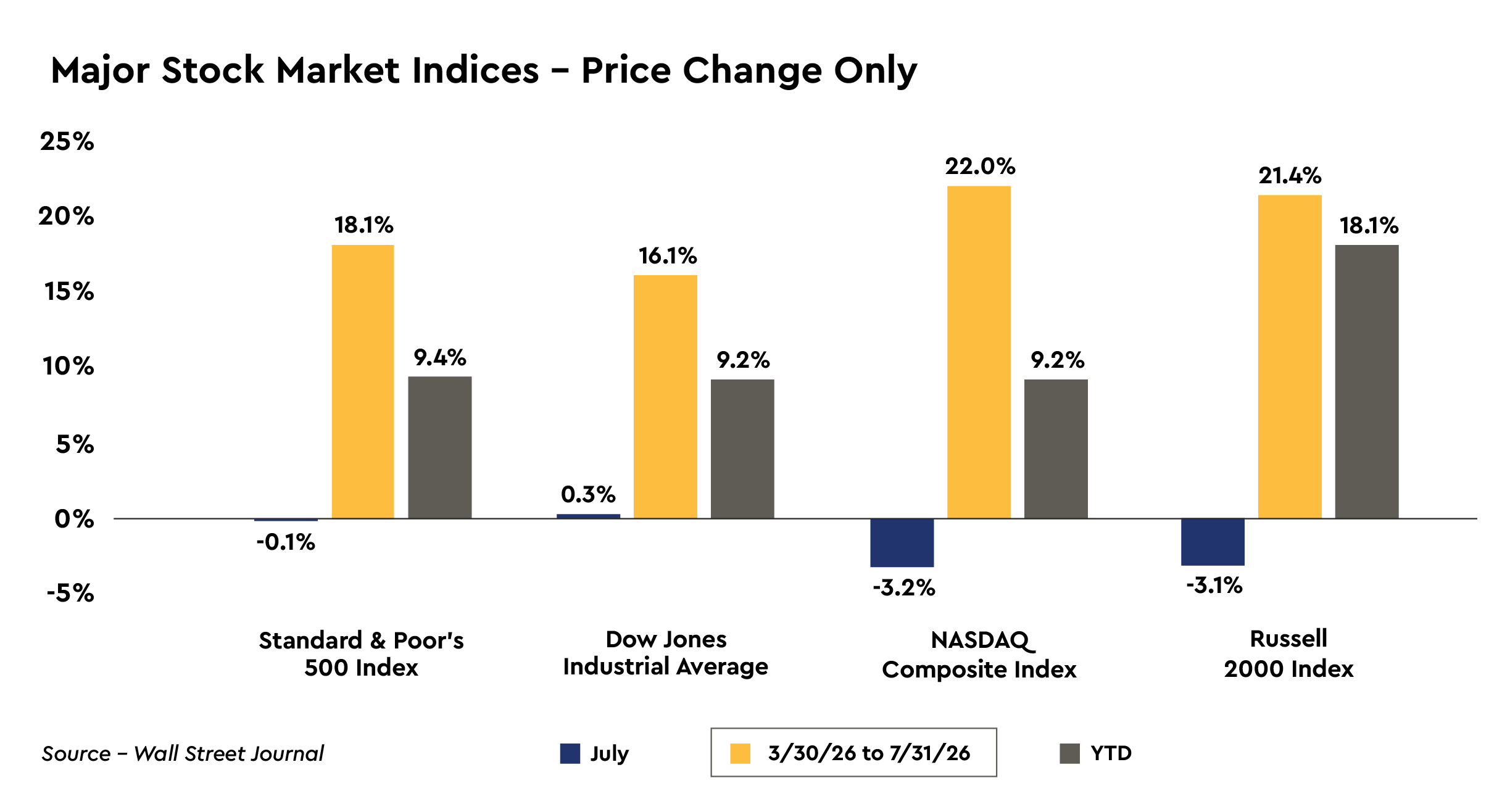
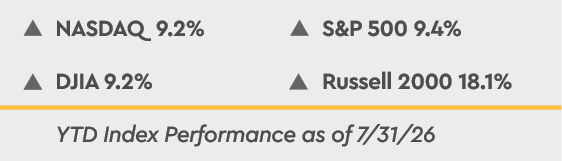
Despite renewed fighting between the U.S. and Iran last month, which was accompanied by a sharp rebound in oil prices, the S&P 500 was largely unchanged at -0.1% during July and the DJIA rose slightly with a gain of 0.3%. Concerns over the massive scale of the spending on the AI infrastructure buildout and the growing need to tap the capital markets to fund it led to a -3.2% drop in the technology-heavy NASDAQ Composite, while the Russell 2000 index of small company stocks pulled back -3.1%. For the first seven months of 2026, the major stock market measures are higher by 9.2% to 18.1% with the Russell 2000 continuing to lead the way this year.
Investors Question Commitment to Reign in Inflationary Pressures
The Federal Reserve left the target range for the federal funds rate unchanged at 3.5% to 3.75% at the July 28-29 FOMC meeting. Three Committee members, all Federal Reserve Bank Presidents who have expressed concern over the persistence of inflationary pressures, wanted to hike rates by 25 basis points. The dissents underscore how pressure is building on the Committee to respond to inflation running above the Federal Reserve’s 2% target for five years. The policy statement was almost identical to the one following the June 16-17 FOMC meeting and again concluded with the same demonstrative statement, “The Committee will deliver price stability.”
The outcome of last week’s FOMC meeting was the least predictable in many years. The impact that oil prices is having on the inflation data is part of the reason, along with the growing uncertainty over how the Iran war will play out. Additionally, Federal Reserve Chairman Warsh has abandoned his predecessors’ hints at future policy moves referred to as “forward guidance,” preferring to not guide the markets’ expectations of policy outcomes, along with Committee members being unusually split in their views this year about the appropriate path of policy.
In the press conference following the meeting, Mr. Warsh was hit with the question “What are you waiting for?” with commodity prices and Treasury yields rising and the inflation data continuing to run in a range of 3% to 4%. Chairman Warsh said the Committee undertook a “rigorous review of the economic situation,” trying to understand what is driving economic growth, and possibly more importantly at the moment, what is driving the “elevated” level of inflation, what role are “shocks” such as oil prices and tariffs playing currently, and how they could impact inflationary pressures in the months ahead.
We thought that the Federal Reserve had the luxury of being patient because the impact of higher oil prices on inflation would be temporary if an end to the Iran conflict developed with the Strait of Hormuz reopening and the disruption of oil flows coming to an end. As already stated, however, the uncertainty over how the Iran conflict will play out has only risen over the past month. Further delays in ending the war will maintain upward pressure on oil prices and raise the likelihood that the Federal Reserve turns to one or more rate hikes before year end.
The central bank will be trying to thread the policy needle over the next few months as tightening policy in response to an oil supply shock will not directly lower oil prices, it will restrain aggregate demand and employment, and in that respect reduce upward pressure on oil prices over time. Additionally, the rise in Treasury yields over the past five months has raised borrowing costs on car loans to home mortgages, tightening financial conditions and effectively tapping the brakes on the economy while the central bank has been on hold.
The futures market for the federal funds rate is pricing in a 67% chance of a rate hike at the September 15-16 FOMC meeting, while the yield on the two-year Treasury note at 4.30% is 67 basis points above the 3.63% midpoint of the 3.50% to 3.75% range, pointing to more than two rate hikes over the next year or so.
Massive Scale of AI Infrastructure Buildout Worries Investors
While the development of artificial intelligence is widely regarded as the most disruptive shift in human history, the questions and uncertainties it raises are profound. AI is already impacting our daily lives and workplaces, and its influence is expected to accelerate in the years ahead. Unlike past technological revolutions that automated physical tasks and labor, AI automates many aspects of cognitive work. It has the potential to accelerate innovation across a wide swath of sectors, drastically reduce research and development timelines across many disciplines, fundamentally change how workers and businesses operate, and open new avenues for economic growth and investment.
The earnings power of semiconductor companies -- the backbone of the AI infrastructure buildout -- remains rock solid, but there are questions about the sustainability of earnings growth across the technology sector. Earnings growth for semiconductor firms increasingly comes from hyperscaler investments (Amazon, Google, Microsoft, Meta, and Oracle); hyperscalers generate revenue from large language model providers (Open AI, Anthropic, Google, and Meta to cite just a few), and sectors outside technology need to demonstrate that demand for AI tools is sufficient to power all parts of the technology sector to drive returns that satisfy the return on investment required of the hyperscalers and large language model providers.
As the hyperscalers have bet their futures to varying degrees on the omnipresent role that AI is expected to play in all aspects of the economy and daily life in the future, an arms race has exploded as the companies invest in data centers filled with powerful semiconductor chips that will make it possible to deliver the computing needed to process AI queries.
With the AI buildout reaching levels few could have imagined just a couple years ago, the financial profile of the hyperscalers is undergoing a dramatic transformation -- from business models that were cash rich and asset light with exceptionally strong, resilient balance sheets with high levels of liquidity, low leverage, and significant capital reserves to business models that are increasingly dependent upon heavy capital expenditures with increasing use of leverage in order to make the investments necessary to compete for long term AI leadership. The surge in borrowing this year by the hyperscalers is weighing on the debt markets and boosting the cost of borrowing as free cash flow has shifted from the hyperscalers to the semiconductor companies.
Consequently, investor sentiment for the hyperscalers has been dampened for the better part of a year as investors are weighing the free cash flow of the hyperscalers in the aggregate turning negative this year, making them increasingly reliant on the capital markets to finance the AI infrastructure buildout, versus the potential for the future returns and profit growth to justify the continued investment. Free cash flow for the hyperscalers is expected to remain under pressure for the foreseeable future as the data center buildout continues to ramp.
Investors worry about a replay of the telecom boom/bust of the Nineties and the housing boom/bust from 2002 to 2010, both episodes characterized by massive speculative overbuilding with supply far outstripping demand. The AI buildout is completely different with demand for compute growing very rapidly and the shortage of computing power driving the surge in AI capital expenditures. Today, investments in data centers and power plants typically require long-term contracts from large, lowly leveraged investment grade companies before the capital expenditures start.
Related concerns are whether future data center spending by the hyperscalers can only be accomplished with an unwelcome dilution of current shareholders and/or a downgrade of credit worthiness as debt burdens rise with future capital raises. Additionally, share repurchases, which historically have been massive in scale and provided a consistent bid for the stocks of technology companies, have been sharply scaled back or paused by the hyperscalers, redirecting billions of dollars from buyback programs into aggressive capital expenditures for AI data center infrastructure. Investors need to watch the response of the capital markets to future capital raises by the hyperscalers to gauge the risks of the AI buildout becoming speculative or if a particular company is overextending itself.
Earnings Carry the Day
For the past two years strong earnings growth has allowed the stock market to successfully climb a wall of worry. While worrisome headlines can lead investors to focus on headwinds that could blunt the market’s continued advance, unless those headlines are able to derail the advance in earnings, the market typically has the wherewithal to continue its climb.
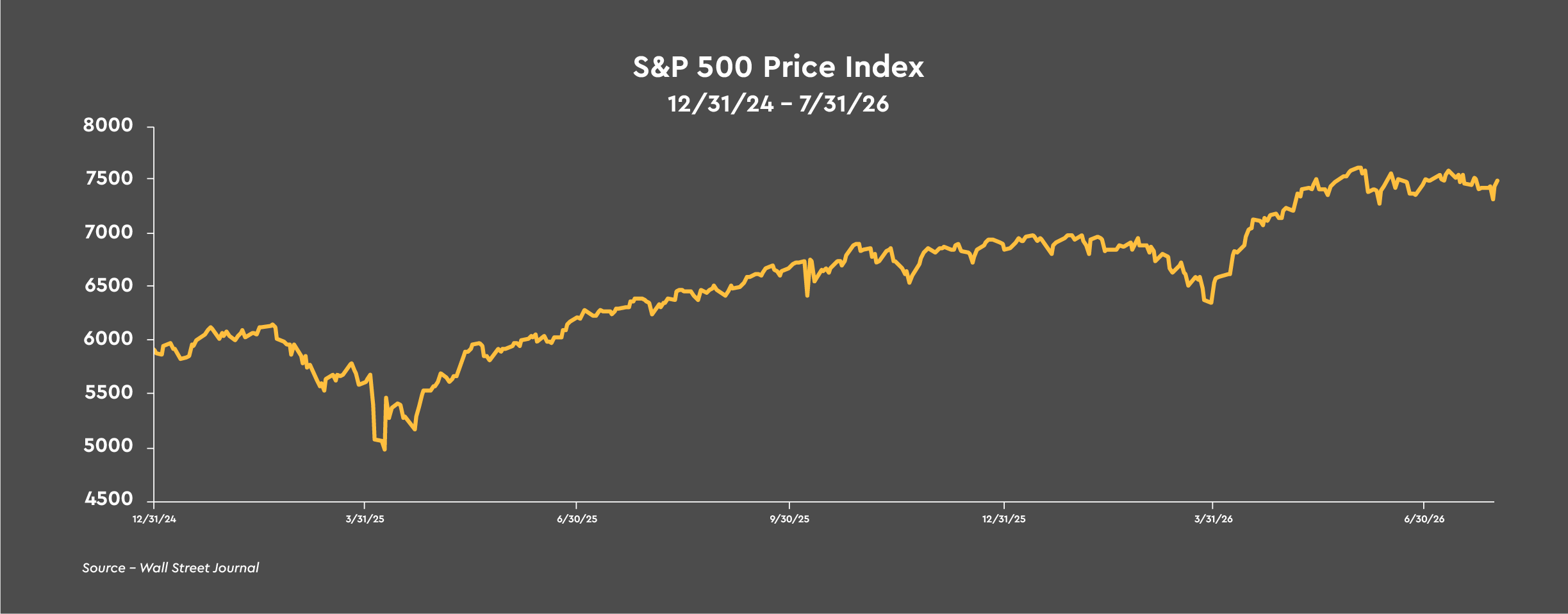
In 2025, the onslaught of tariff announcements caused consumers to become defensive with consumer sentiment measures cratering and businesses to become increasingly hesitant to make hiring and business capital spending decisions. While weakness in the labor market was an unintended consequence of the major shift in tariff policy, operating earnings on the S&P 500 companies grew 14% over the four quarters of 2025, compared to the long run earnings growth rate of 7.25% since the end of WWII.
Currently, investors are facing heightened geopolitical concerns, slower growth with the push higher in energy prices, inflation persistently above the Federal Reserve’s 2% target, and the possibility of one or more rate hikes over coming months, leading investors to start questioning the sustainability of the economic cycle.
Despite these worries, operating earnings grew 21.8% on a year-over-year basis in 1Q 2026, and with 61% of companies reporting, operating earnings for the S&P 500 companies are projected to have grown 28.7% on a year-over-year basis in 2Q 2026. The consensus forecast provided by FactSet is for operating earnings to grow 24.8% over the four quarters of 2026, another significant advance. Strong earnings continues the two year long trend of lowering price-to-earnings ratios with earnings growing at a faster pace than stock prices are rising.
The backdrop for further gains in stock prices is positive with the economy growing at a pace close to its 2.0% long run growth rate since 1970, above trend earnings growth with expanding profit margins, inflation that is above the Federal Reserve’s 2% target, but relatively well contained with inflation expectations out to five and ten years below 2.3%, and leadership at the Federal Reserve that says it is committed to bringing inflation down to target. Inflation that is elevated, but contained, is a sweet spot that supports revenue growth for cyclical and smaller companies, without forcing the central bank to aggressively tighten monetary policy, which supports a broadening of the advance in stock prices.
Clearly the biggest risk to common stocks currently is the ongoing conflict with Iran. It appears both Washington and Tehran have run up against the limits of what they can achieve through military force with neither side so far capable of achieving a decisive advantage over the other. U.S. military officials stated last week that “air power has its limits” in achieving military objectives. Iran has been able to effectively close the Strait of Hormuz, and the Iran-backed Houthi militia has been able to disrupt shipping in the Bab al-Mandeb strait.
It seems to us that the U.S. blockade of Iran’s ports, which deprives the regime of $400-$500 million a day in oil revenue, is the key point of leverage the U.S. has over Iran. The unknown is even if the U.S. can hold its ground long enough in the face of a looming critical supply shortage of crude oil and refined products on the global energy markets, which could possibly lead to new all-time high energy prices, what is to keep the Iranian regime from closing the strait again once their oil coffers have been refreshed? Time will tell if a long lasting agreement can be put in place with the current regime in control of Iran.
Treasury Yields Continue to Rise
Treasury yields rose while inflation expectations collapsed during June following a stunning drop in oil prices after the U.S. and Iran entered into a 60-day ceasefire and an unexpectedly hawkish June FOMC meeting. With the rebound in oil prices last month after hostilities in the Middle East restarted and the economy remaining resilient with strong consumer spending and the AI/data center buildout powering ahead business capital spending on information processing equipment, software, research and development, and industrial and transportation equipment, Treasury yields rose further during July.
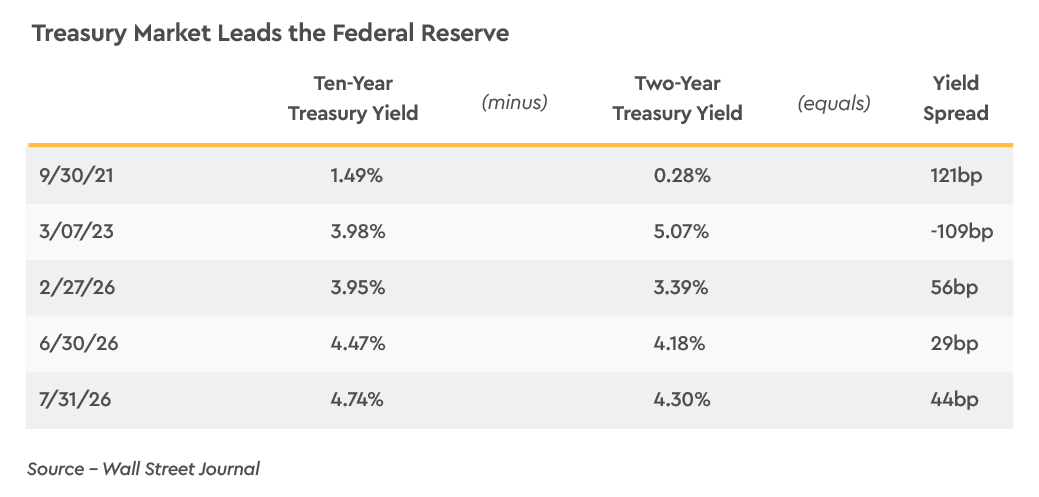
At the shorter end of the yield curve, despite the yield on two-year Treasury notes rising to 4.30% by the end of July from 4.18% on June 30, the inflation expectation over the next two years declined another -11 basis points to 2.17% after collapsing a stunning -42 basis points during June. The real two-year Treasury yield rose to 2.11% from 1.88% at the end of June and 1.29% at the end of May as investors raised their growth outlook.
An even larger rise in yield took place at the longer end of the Treasury yield curve as the yield on ten-year Treasury notes rose to 4.74% at the end of July, with the ten-year inflation outlook unchanged at 2.27% as the nation’s rapidly deteriorating fiscal situation lowers investor appetite for longer dated debt. The real ten-year Treasury yield rose 27 basis points to 2.47%, its highest level since June 2006.
 Given our well documented concerns over the size of the federal budget deficit and the ballooning national debt that is currently carrying an interest expense of $1 trillion per year, we recommend intermediate term securities in the five to seven year range rather than longer maturity securities. Adding corporate securities to the mix will increase the real return on the fixed income portfolio. That medium term exposure can be barbelled with holdings at the shorter end of the Treasury yield curve which is still elevated due to the heavy insurance of Treasury bills to finance the federal budget deficit.