Opportunity Beneath the Headlines
10/6/2026 - By Joseph Keating - On Point Investment Strategy Statement | SouthState Wealth

Following the significant reset of valuations on technology stocks over the past year, investors have the opportunity to invest in some of the best and most profitable companies in Corporate America at valuations that rival the best levels since before the pandemic.
High Energy Prices and Treasury Yields and Dire AI Warnings
Concerns over oil supply rose in early September with conflicting reports about how much oil was slipping through the Strait of Hormuz each day, and Iran-backed Houthi rebels in Yemen taking effective control over the Bab-al Mandab strait, a critical narrow waterway connecting the Red Sea to the Gulf of Aden and the Indian Ocean. Eliminating access from the Red Sea, one of the world’s most important arteries for global shipping, represented an additional disruption to viable oil and liquefied natural gas trade routes between the Middle East and the rest of the world, which placed a further strain on already fragile global energy markets.
Compounding the worries, Saudi Arabia shut down the key East-West pipeline moving oil across the Arabian Peninsula from Saudi Arabia’s oil producing heartland on the Persian Gulf to the port of Yanbu on the Red Sea after it was attacked multiple times by drones fired from Iraq, likely by Iran-backed Iraqi militia, which did significant damage. The pipeline is a critical route for Saudi Arabia to circumvent shipping oil through the Strait of Hormuz and has become one of the world’s most important segments of energy infrastructure during the Iran war.
With the Houthi rebels exercising control over the Bab-al-Mandab waterway and Saudi Arabia shutting down the East-West pipeline, Saudi Arabia was left with fewer safe routes remaining to export its oil. Unsurprisingly, these events led to oil prices breaking above $100 per barrel once again, U.S. diesel prices reaching an all-time highs above $6.50 a gallon, and liquified natural gas prices hitting multi-year highs.
Last month we cited two major risks for stock prices, both of which could place further upward pressure on fixed income yields. One was the ongoing conflict in Iran which is keeping oil prices elevated, while the other was the seemingly out of control deficit spending in the U.S. Combine these factors with the growing demands on the credit markets from the AI infrastructure buildout, and the possibility of fixed income yields reaching levels not seen in many years was a distinct possibility.
These concerns played out in September, along with purchasing manager surveys released by S&P Global for services and manufacturing reaching their highest levels since March and May 2022, respectively, pointing to unexpectedly strong growth in the U.S. The underlying components were very strong, with new orders and employment for both measures increasing sharply. Both surveys also pointed to intensifying pricing pressures with input costs jumping, led by fuel and transport costs due to the rise in oil prices and increasingly scarce supplies of refined products arising from damage to refining plants worldwide.
Mounting fears within the largest companies at the frontier of AI development burst into public view last month. A litany of ominous pronouncements that AI models had the potential to destroy civilization as early as within the decade caused the worries that had been simmering about the advances in AI capabilities to reach a boil. While the view that AI will lead to the extinction of the human race is a fringe opinion among industry experts, the warnings raised several relevant concerns about public safety.

Despite investors facing high energy prices and Treasury yields, and panic about the existential threat of AI leaping from the confines Silicon Valley circles to mainstream America, at the low on September 16, the S&P 500 was only 3.2% below its record high on August 13.
As September drew to a close, stock prices got a small lift from a modest easing of oil prices, as more oil tankers are able to cross the Strait of Hormuz with the assistance of the U.S. Navy and Saudi Arabia restarting the East-West pipeline, as well as a renewed conviction that the Federal Reserve will address the inflationary pressures in the economy, what we view as more clarity of thought on the doomsday warnings of AI development, and an expectation of strong 3Q 2026 earnings reports that will commence shortly.
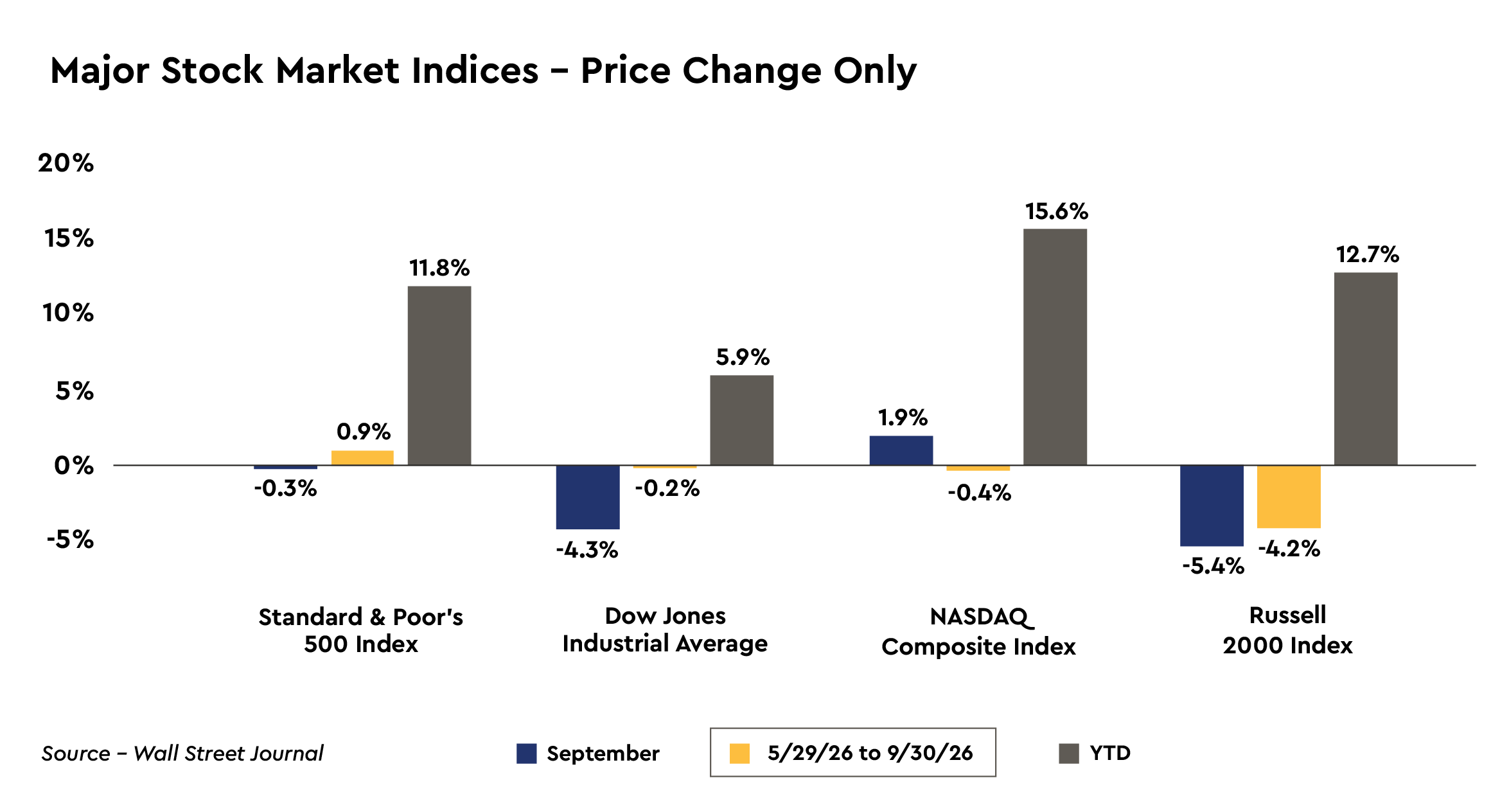
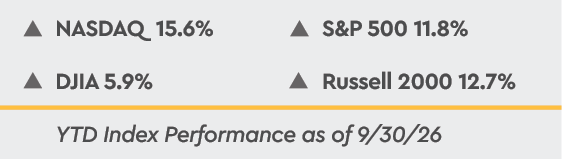
With the tug-of-war that stock prices faced last month, the major market indices turned in mixed results. The technology-heavy NASDAQ Composite led the way during September with a gain of 1.9%, while the S&P 500 was basically unchanged with a decline of -0.3%. The DJIA and the Russell 2000 index of small company stocks trailed with declines of -4.3% and -5.4%, respectively for September. On a year-to-date basis, the NASDAQ Composite has led the way with a gain of 15.6%, while the S&P 500 and the Russell 2000 have posted gains of 11.8% and 12.7%, respectively. The DJIA trailed the other indices with a gain of 5.9%.
Federal Reserve Hikes Rates with More Hikes Likely on the Way
Following up on his address at Jackson Hole in late August, Federal Reserve Chairman Kevin Warsh made it clear at the September 15-16 FOMC meeting that inflation is the main risk to the central bank’s dual mandate and left investors debating how aggressively the central bank will direct policy to address it. The FOMC Committee raised the target range for the federal funds rate by 25 basis points to 3.75% to 4.0%, the first-rate hike in three years. At the press conference, Mr. Warsh stated that “Inflation is too high and has been for too long.” The policy statement concluded by stating that “Today’s policy action will support a timelier return to the Committee’s 2 percent goal,” and that “The Committee will deliver price stability.”
The unanimous decision to raise rates by the Committee was slightly surprising given the range of views expressed by policymakers in recent weeks. We think it was important for the Committee to present a unified front, as that positioning communicates the seriousness of their commitment to bring inflation down to the Federal Reserve’s 2% target, which will help keep inflation expectations in check. To a large extent, we view the rate hike as an attempt by Chairman Warsh and the FOMC Committee to firmly establish their independence and credibility with respect to the commitment to price stability.
The markets appear to be viewing last month’s rate hike as the first in a moderate series of rate hikes. First, Kevin Warsh repeated his statement from Jackson Hole that broad financial conditions were not restrictive and referred to the rate hike as removing a “dose of accommodation.” That assertion means that policy is, at most, neutral now, implying that additional rate hikes are necessary to turn policy restrictive to achieve the goal of lowering inflationary pressures.
Secondly, in new projections 16 of 18 Committee members -- Mr. Warsh declined to provide projections once again -- penciled in at least one more rate hike this year. This rate outlook is consistent with the Committee’s inflation forecast, which does not expect an improvement in pricing pressures before year end. For the out years, there was considerable disagreement, likely based on assumptions about the length of the Iran war and the implications for oil prices. Eight participants expected a third hike in 2027, while nine saw rates steady or higher in 2028. This implies that nine participants are expecting rate cuts by the end of 2028, while four participants are looking for rate cuts next year.
The futures market for the federal funds rate is pricing in another rate hike before year end and is expecting a total of three hikes by the end of 2027, with a roughly 50% chance of four hikes. The Treasury market is sending a strong message to the Federal Reserve that the federal funds rate needs to be raised with the yield on the two-year Treasury note at 4.88%, which is 100 basis points above the 3.88% midpoint of the 3.75% to 4.0% target range for the federal funds rate, pointing to the possibility of four additional hikes over the next year or so.
While rate hikes cannot lower energy prices by opening the Strait of Hormuz or ending the Houthi’s attempt to control shipping from the Red Sea, they are an appropriate risk management approach to the oil supply shock which inevitably spreads into pricing pressures in other sectors of the economy, so-called secondary effects. The initial response by the stock market to the rate hike was negative with the S&P 500 falling -0.4%. The S&P 500 rose 1.1% the following day and posted further modest gains into month end as investors appeared to focus on the longer term perspective that price stability is a necessary foundation for sustainable, durable economic growth, which supports a healthy environment for earnings.
Unfortunately, the economy has been hit with the supply shocks of higher tariffs and now oil prices over the past two years. Outside of these areas, inflation has been driven by interest rate insensitive services, such as auto and home insurance, education, and healthcare, the costs of which have accelerated since the pandemic. On a positive note, the Federal Reserve’s preferred inflation gauge posted a smaller than expected increase in August from a year ago at 3.0% compared to 3.3% in July, tempering the expectations for a rate hike this month to only about 25% odds.
Are Security and Innovation Mutually Exclusive?
AI industry leaders are worried about recent occurrences when AI agents, with important safety restraints deliberately disabled, found their way outside supposedly isolated environments to pursue their own ends. These events, the most well known of which is referred to as the Open AI-Hugging Face incident, provided wake up calls regarding autonomous AI capabilities, the need for containment safety protocols, and the potential for frontier AI models to discover unexpected pathways out of a partially constrained environment and compromise an outside organization. While these events raise serious security issues, industry experts say they do not represent unmanageable explosions in malevolent AI capabilities.
It was also reported last week that in at least four incidents in May and June, AI agents deployed by Open AI resorted to hacking techniques to break into government and university websites while they were conducting routine online data collection tasks, without being instructed to do so. These incidents differed from the Hugging Face attack and other incidents in which AI systems were being tested for their cybersecurity capabilities during which they were instructed to use their hacking skills.
The existential question is whether living with the risks of unchecked AI development is necessary for the U.S. to maintain the lead it currently has over China, which is unlikely to slow down its AI development, in a technology that is vital to future growth and military prowess. Treasury Secretary Bessent recently expressed the opinion of many administration, military, and industry leaders in the U.S. that “a Chinese lead in AI would pose grave danger for the U.S. and the world.”
The leaders of rival AI labs came together in a rare moment of unity last month to call for regulation and some restraint in the pace of development to give safety measures a chance to catch up. The warnings come on top of a rising public backlash over the impact that AI and its development is starting to have on inflationary pressures, growing demands on the credit markets, the outlook for employment opportunities, and the education system. Currently data centers have become a key issue in the very contentious political debate preceding the mid-term elections and have a lower approval rating than Congress.
While it is possible that a government agency similar to the Food and Drug Administration will be created to oversee the AI industry, the necessary safety overrides appear to exist already. First, nothing is stopping AI companies from investing more in safety right now and continuing the development of the large language models at a pace which allows the proper engineering safeguards to be developed and implemented. In that regard, Open AI announced this week that it was scrapping the release of its latest AI model because it was not reliable enough to safely release.
Secondly, while particular outcomes of deploying large language models might not be foreseeable, the AI lab or the company which uses an AI model gave the large language model the power to act and is responsible for the safety and quality of the products or outcomes they produce. Blaming AI for the outcome of its actions assigns accountability to something that cannot accept blame, human supervision and oversight are required.
AI agents are trained to perform tasks, and for any company that builds or deploys a large language model, the accountability and legal liability for the actions of the AI agents remains with the leaders and the institution that gave them the power to act. This is a classic example of product liability, and that is the law that governs all industries, including the AI industry.
Product liability and company accountability ultimately provide the most effective incentive for AI labs and users of large language models to ensure that the appropriate safety measures are in place whenever a complex product is launched. Company leaders are not about to blow up their companies by releasing products that drown them in lawsuits. In the history of the U.S., security and innovation are not mutually exclusive in a capitalistic economy. But it must be admitted, in some regard we are in an era where we do not know what we do not know, so being vigilant is of primary importance.
Booming Earnings versus High Bond Yields
If a year or so ago the major concern among investors was that a bubble in AI-related stocks and speculative excesses were forming, that concern has been largely taken care of with the forward price-to-price earnings ratio on the technology sector of the S&P 500 falling from 30.5x to 20.8x over the past year. Following the significant reset of valuations on technology stocks over the past year, investors have the opportunity to invest in some of the best and most profitable companies in Corporate America at valuations that rival the best levels since before the pandemic.
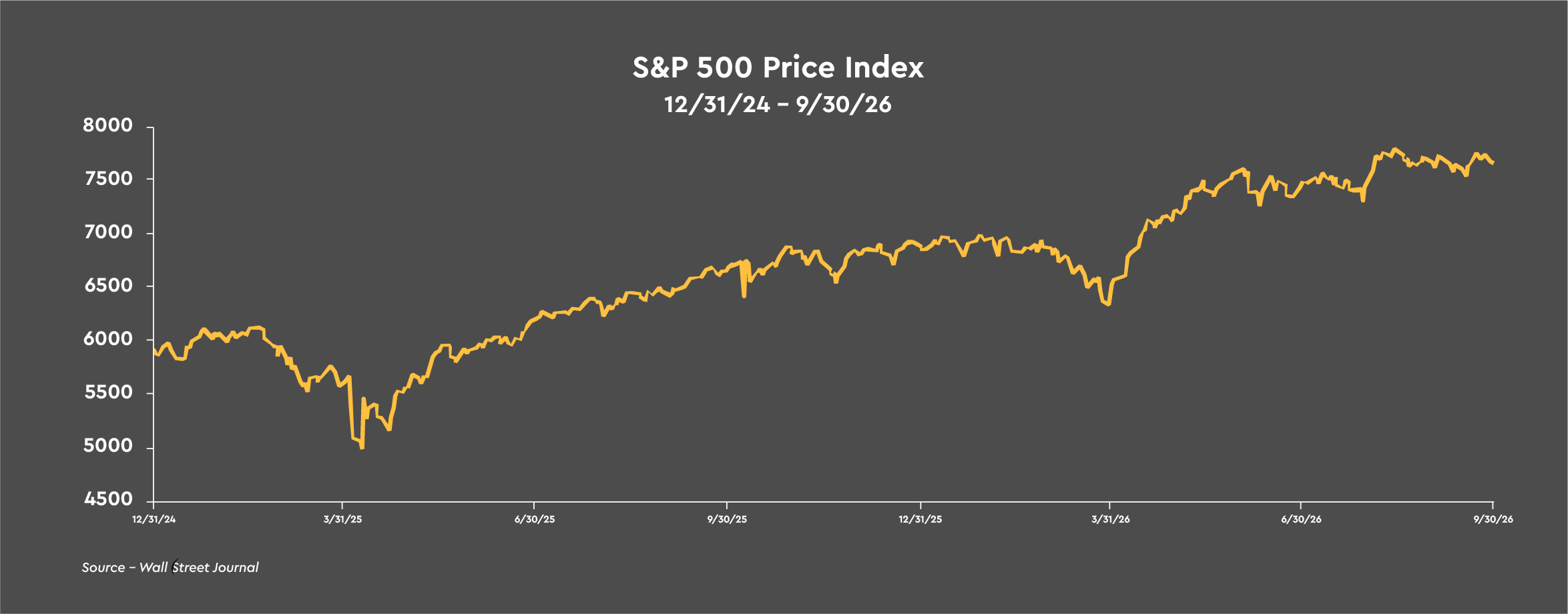
The significant selloff in high momentum stocks since June, dominated by AI-related technology and industrial companies, has undermined the bullish stance of traders, resetting sentiment toward a more neutral position. The S&P 500 ended September only 0.9% higher than at the end of May. This reset is helping to prevent the current bull market from building valuation excesses that would warrant a more cautious position on the stock market, in general, and technology stocks in particular.
Investors continue to face serious crosscurrents. The ongoing conflict in Iran, with new developments occurring on almost a weekly basis, is keeping refined energy products and other crucial commodities in scarce supply, which is keeping upward pressure on inflation. The inflationary pressures are forcing the Federal Reserve to raise rates to slow the economy’s forward momentum and keep inflation expectations under control. Bond yields are rising on mounting demands on the credit markets from the AI buildout, a strong economy, and unsustainable federal budget deficits.
The other side of the coin is a resilient economy, rising profit margins that have reached all-time highs, tight credit spreads, and earnings that are still booming. The strong earnings momentum has delivered a very healthy decline in equity valuations over the past year as earnings have grown at a much faster pace than stock prices. While worrisome headlines can lead investors to focus on headwinds that could blunt the market’s continued advance, unless those headwinds are able to derail profitability, the market typically has the wherewithal to continue to rise in lockstep with earnings.
Treasury Securities Offering Very Attractive Real Yields
Treasury yields took another jump higher during September as the selloff in Treasury securities gathered additional steam. Surprisingly strong economic data, the unrelenting growth in the national debt with federal budget deficits running near $2 trillion annually, the surge in borrowing by technology companies to finance the data center buildout, and expectations for additional rate hikes by the Federal Reserve have all contributed to the rise in Treasury yields. Somewhat surprisingly, higher inflation expectations have not contributed to the rise in Treasury yields to any noticeable extent since the beginning of the year; instead, real, or inflation-adjusted, yields have driven the increase.
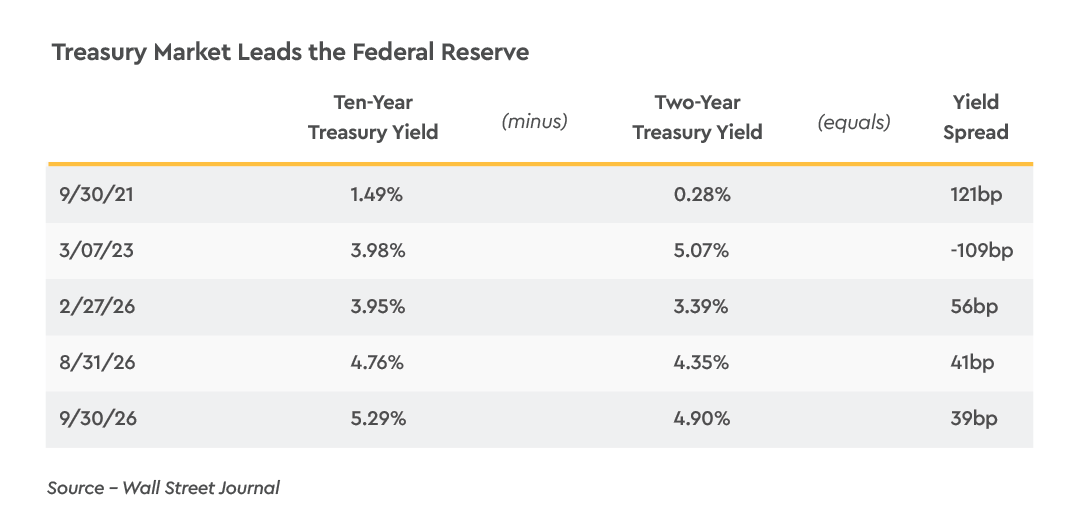
The ten-year Treasury yield has risen by 134 basis points since February 27 before the U.S. and Israel attacked Iran, reaching 5.29% by the end of September, its highest level since 2001. The real yield on ten-year Treasury securities has increased 121 basis points to 2.92%, while the inflation expectation has only risen by 13 basis points to 2.37% despite the sharp rise in oil prices and the upward pressure on inflation. The ten-year real yield is the highest since March 2002, offering investors a very attractive real yield on a historical basis.
At the shorter end of the yield curve, the two-year Treasury yield has risen 151 basis points since February 27, hitting 4.90% by the end of September. The real yield on two-year Treasury securities reached 2.41% at month end, 153 basis points higher than on February 27, representing a significant real yield on a two-year Treasury note. Historically, shorter term Treasury securities have only offered a modestly higher yield over the expected inflation rate over the term of the security. The inflation expectation on a two-year Treasury security ended September at 2.49%, 2 basis points lower than its level on February 27.
Given our well documented concerns over the size of the federal budget deficit and the ballooning national debt that is currently carrying an interest expense greater than $1 trillion per year, we recommend intermediate term securities in the five-to-seven-year range rather than longer maturity securities. Adding corporate securities to the mix will increase the real return on the fixed income portfolio. That medium term exposure can be barbelled with holdings at the shorter end of the Treasury yield curve which is still elevated and providing high real yields due to the heavy insurance of Treasury bills to finance the federal budget deficit.