Common Stocks Post Gains in January
2/1/2025 (Updated: 4/3/2026) - By Joseph Keating - On Point Investment Strategy Statement | SouthState Wealth

Equity Markets
Despite Several Crosscurrents, Common Stocks Post Gains in January.
The investor lethargy that swept over the markets during December carried over into the first half of January, supported by a strong employment report for December which kept alive worries that President Trump’s economic policies could overheat the economy and lower the likelihood of rate cuts later this year. Investors were also concerned that Mr. Trump’s trade and immigration policies could lead to a rekindling of inflationary pressures.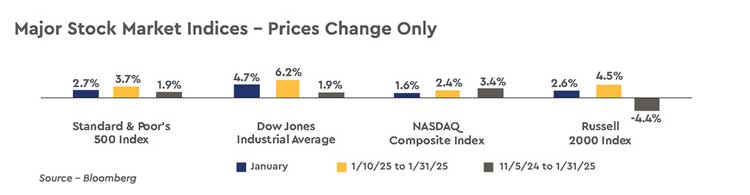
Investor sentiment took a turn for the better midmonth following a couple of cooler than expected inflation reports, a strong start to the 4Q 2024 earnings season, and a renewed optimism around a business-friendly administration. The modest pullback in stock prices over the five weeks ending January 10 removed a good bit of the froth that built up in investor sentiment following Donald Trump’s election victory and the Republican party carrying majorities, admittedly small, on both sides of Capitol Hill. Scaling back the surge in investor sentiment provided a healthy reset that helped the bull market in common stocks roll forward over the back half of the month.
Investors appeared to be reluctant to miss out on a revival of animal spirits that could flood over the markets with President Trump returning to the Oval Office, and started accumulating stocks in order to be positioned to benefit from the lift to the economy and earnings that could emerge from a new round of business-friendly policies.
That buying interest ran headlong into a narrow — any company vaguely related to artificial intelligence (AI) — and short-lived selloff in common stocks last week on the news that Chinese AI startup DeepSeek has developed open source, large language models that appear to be roughly on a par with top U.S. rivals on certain benchmarks that are used to evaluate AI intelligence performance.
Supposedly, these models were developed at a fraction of the cost that AI models have been developed in the U.S., calling the expected outsized hyperscale capital spending ramp into question. While winners and losers could emerge over time from this breakthrough, the overall economy should benefit from artificial intelligence development becoming more efficient and cost effective. Less expensive AI could unlock applications in industries and on devices previously priced out of the AI revolution, which raises the likelihood of a significant productivity surge on the horizon.
To the relief of many investors, Mr. Trump stopped short of authorizing new tariffs on his first day back in the White House. However, President Trump’s ongoing references to the revenue generating potential from tariffs implies that the lack of official day one action on tariffs is more likely a delay in finalizing the approach as he awaits Senate confirmation of the members of his economic policy team. Investors seem to be betting that a more deliberate approach, heavy on negotiating tactics, will win out over large, broad-based tariff hikes.

The Federal Reserve Delivers a “Hawkish” Pause in the Rate Cutting Cycle.
As widely expected, the Federal Reserve left the target range for the federal funds rate unchanged at 4.25% to 4.50% at the January 28-29 FOMC meeting, entering a new wait and see phase. In pausing the rate cutting cycle which began last September, the price stability portion of the central bank’s dual mandate took precedence over the maximum employment portion of its mandate which held sway over the final four months of 2024.The hawkish slant to the policy statement was not found in what was contained in the statement, but rather in what was omitted. Specifically, the Committee removed the line, “Inflation has made progress toward the Committee’s 2 percent objective” and now simply states that inflation “remains somewhat elevated.” This was a subtle but important change to the policy statement. Chair Powell went on to say at the press conference that the Committee will need to see “real progress on inflation” or unexpected weakness in the labor market before considering further rate cuts.
Mr. Powell reaffirmed the view we laid out in last month’s Investment Strategy Statement that while the FOMC Committee remains data dependent regarding future policy moves, it has also become policy dependent following the election. Chair Powell said the FOMC Committee is waiting to see how the policy agenda — specifically trade, immigration, regulation and fiscal policies — are articulated and will react accordingly.
While all of the referenced policies could impact either side of the central bank’s dual mandate, it appears the Federal Reserve is most uneasy about the possibility of the Trump administration raising or imposing new tariffs. If tariffs are primarily a negotiating tactic, there would not be any impact on inflation. If tariffs are a “one and done” event, then no adjustments to monetary policy would be necessary as long as businesses and households expect inflation to remain low, and because, at worst, they would represent a one-time bump in prices, not the start of an inflationary cycle.
However, if tariffs are imposed incrementally, at different times to different countries and on a wide array of goods, then the inflationary implications could become more significant. The reason is consumers’ and businesses’ inflation expectations can become self-fulfilling if households and businesses expect prices to be persistently higher.
Federal Reserve officials are attempting to thread the needle as they navigate two risks. One is that they ease policy too aggressively, particularly with the Trump administration promising a progrowth policy agenda along with tariffs and tougher immigration policies, which collectively risks undoing some of the recent progress on inflation. The central bank does not want to be forced to start hiking rates later this year because progress on lowering inflation stalled at a rate near 3% or higher, let alone a rekindling of inflationary pressures.
The other risk is that they want to lower the likelihood that the aggressive rate increases from March 2022 through July 2023 could unnecessarily weaken the labor market now that price and wage growth has receded from recent peaks. Leaving policy too restrictive for too long would allow high real rates to continue to take a toll on the economy, particularly on middle to lower income households and small to mid-sized businesses which have borne the brunt of the rate hikes. The one percentage point that the central bank lowered rates over the last four months of 2024 has lowered the risk of a significant softening of the jobs market.
Economy Grew at a Solid Pace in 4Q 2024.
The economy continued to grow at a solid pace in 4Q 2024. Real GDP advanced at a 2.3% annual rate, bringing the economy’s growth rate over the four quarters of 2024 to 2.5%, slightly faster than the average annualized pace of 2.1% over the past twenty years. Digging into the data, the headline growth rate for the economy somewhat understated the strength in the economy as a much slower pace of inventory accumulation subtracted 0.9 percentage points from the economy’s growth rate last quarter. If the pace of inventory build had been unchanged, the economy’s growth rate in 4Q 2024 would have been a much stronger 3.2%.Consumer spending contributed more than 100% of the economy’s growth last quarter, advancing at a 4.2% pace. Goods outlays grew at a strong 6.6% rate, led by a 12.1% surge in durable goods outlays, such as recreational goods and motor vehicles. Outlays for goods were helped along by goods prices falling at a -0.5% rate during the quarter, while real disposable personal income grew at a 2.6% annual rate as the labor market remained healthy. There also could have been some pull forward in December by consumers buying in advance of the possibility of higher tariffs. Spending on services was a touch slower at a still solid 3.1% pace.
Residential construction outlays grew at a surprisingly strong pace of 5.3% as prospective homebuyers increasingly turn to new construction as the market for existing homes continues to struggle with an inventory problem, primarily due to the unwillingness of current homeowners to give up the very low fixed rate mortgages they locked in prior to and during the pandemic.
Business capital spending was the weakest sector of the economy last quarter, falling at a -2.2% annual rate, led by a -7.8% decline in equipment outlays. Businesses could have delayed capital outlays in anticipation of accelerated depreciation charge-offs being a part of expected tax policy. The bottom line is the economy posted solid growth last quarter and for all of 2024, continuing its persistent rebound and has entered 2025 with solid forward momentum. The inflation data was mixed, pointing to a stalling in the progress of lowering the nation’s inflation rate to the Federal Reserve’s 2% target. Core consumer prices rose at a 2.5% annual rate in 4Q 2024 compared to a 2.2% pace in the previous quarter and were higher by 2.8% on a year-over-year basis. On a broader perspective, the GDP price index rose at a 2.2% rate versus a 1.9% pace in the previous quarter and was higher by 2.4% year-over-year. In sum, not a reversal of the progress, but a stalling of the progress on lowering the rate of inflation.
Higher Treasury Yields vs. Earnings Growth.
The uncertainty flowing from the yet to be defined Trump administration policies on trade, immigration, regulatory reform, deficit spending, and tax rates can be captured in three numbers, 5%, 4% and 3%. Start with the possibility that the yield on the ten-year Treasury note could be closer to 5% for most of 2025 — currently 4.54% — rather than 4%, the Federal Reserve could keep the policy rate above 4% — currently 4.38% — rather than below 4% for the better part of 2025, and an inflation rate that appears to have stalled in its decline from the mid-2022 peak to a level near 3% — currently in the range of 8% to 3.2% — rather than making further consistent progress toward the Federal Reserve’s 2% target. The potential offset to these uncertainties is the economy being on track for an elongated cycle, helped along by the surge in business sentiment post-election and expectations of a business friendly policy agenda that President Trump will bring to Washington. A longer economic cycle raises the possibility that Corporate America can deliver a meaningful gain in earnings to support higher stock prices.We continue to expect that President Trump will use a targeted approach to tariff policy with a primary focus on outcomes which support domestic manufacturing and production and provide access to foreign markets to which the U.S currently does not have access, such as the European Union vehicle market. Reflecting on Mr.Trump’s first term as president, we anticipate an increase in tariffs on most imports from China, which will largely be offset by the strong U.S. dollar and pricing concessions from Chinese manufacturers which are facing recessionary conditions domestically. Late Friday, President Trump stated that he would impose 25% tariffs on goods from Mexico and Canada on February 1 and an additional 10% tariff on Chinese goods in retaliation for fentanyl being sourced in China and distributed into the U.S. Mr.Trump also said that tariffs on oil from Canada would start mid-month and would be initially levied at 10%.
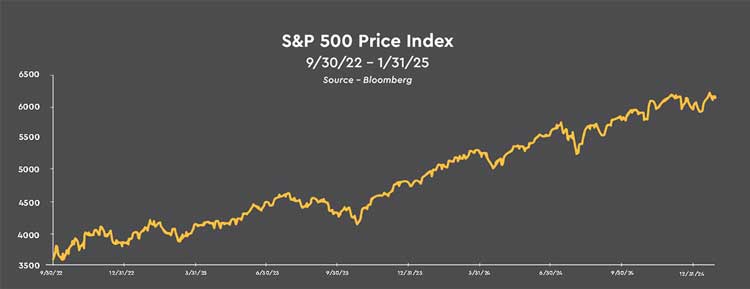
The initial indications are that Mr. Trump is using the proposed tariffs on goods from Mexico and Canada — the top two U.S. trading partners — to pressure the countries to start renegotiating the US-Mexico-Canada trade agreement from 2020 which is up for statutory review in 2026. The key issues are requiring the countries to limit the flow of fentanyl and illegal migrants into the U.S., moving vehicle manufacturing plants back to the U.S., and getting Canada to contribute more military spending to NATO Returns on common stocks this year will likely be determined by the tradeoff between the higher level of Treasury yields and Corporate.
On the earnings front, with 16% of the S&P 500 companies reporting, 4Q 2024 operating earnings are projected to have grown a very strong 13.5% on a year-over-year basis following a gain of 13.2% in the previous quarter. The analysts at Standard & Poor’s are forecasting that operating earnings grew by 9.3% over the four quarters of 2024 and will grow by more than 16% by 4Q 2025.
Looking at history, the cautious shift in the rate outlook by the Federal Reserve at the December FOMC meeting and the pause in the rate cutting cycle last month can be viewed as good news for the outlook for common stocks. Common stocks have tended to perform better when the Federal Reserve is gradually lowering rates, or is on hold, rather than aggressively cutting rates because that means the economy and the financial markets are not under stress, requiring a markedly easier monetary policy in short order.
The biggest risk to common stocks in the near term remains the aggressive rise in Treasury yields from the lows recorded in mid-September and the possibility of yields rising further. Arresting the recent rise in Treasury yields depends largely on the nation’s inflation rate moving persistently and consistently to the central bank’s 2% target.
The Federal Reserve remaining steadfast in pursuing at least a mildly restrictive monetary policy should lead to lower inflation expectations and reinforce the disinflationary trend since mid-2022. A further pickup in productivity could also help lower inflationary pressures by placing downward pressure on unit labor costs. Making progress on lowering the size of the federal budget deficit would also ease some of the upward pressure on Treasury yields.
Lastly, the major risk to stock prices over the next year or so would be the Federal Reserve needing to shift policy to a more restrictive stance to fight a rekindling of inflationary pressures, which would likely reset common stock prices lower. We believe the Federal Reserve is being prudent in pausing the rate cutting cycle due to the forward momentum in the economy, the recent sticky nature of inflation, and the uncertainty and risks around the still to be defined policies of the incoming administration.
The Federal Reserve needs to resist pressure to prematurely lower rates and pursue a policy approach consistent with bringing inflation down to the 2% target, while the Trump administration needs to pursue its policy agenda in a manner that is also consistent with inflation approaching 2%. With the pause at the January FOMC meeting, investor attention has almost completely shifted from the outlook for interest rates to a focus on fiscal, trade, immigration, and regulatory policies with the outlook for the economy now in the hands of the Trump administration for the next couple years.
Policy uncertainty is particularly high currently, primarily due to President Trump’s view on tariffs. Everyone knows they are coming, and the markets received an initial read on tariff policy last week, however, no one is sure exactly which countries, companies, or products will be impacted, to what extent, and for how long. Despite that, we continue to view the backdrop for common stocks as reasonably positive as the economy has entered 2025 with positive forward momentum and appears to be on track for an elongated cycle.
Treasury Markets
Modest Decline in Treasury Yields in January.
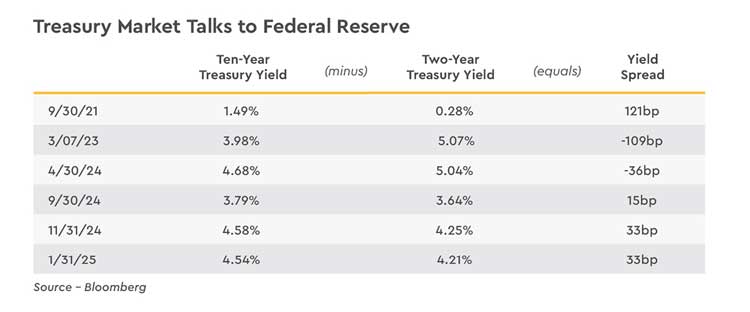
Since mid-September, yields on Treasury securities have been taking their cue less from the Federal Reserve than from the outlook for the economy and inflation and the policy agenda which will be developed jointly by Congress and the White House in the weeks and months ahead. While the Federal Reserve lowered the target range for the federal funds rate by a full percentage point over the final four months of 2024, Treasury yields have risen across the yield curve.While the yield on the ten-year Treasury note fell a modest 4 basis points during January to 4.54% it is still 90 basis points higher than the 3.64% yield the day before the September FOMC meeting. The rise in Treasury yields can be traced to better growth in the economy during 4Q 2024 than expected back in September and the potential for a further pickup in the economy’s growth rate this year.
Investors also seem to be concerned that inflation progress has stalled and could possibly reverse if proposed tariffs prove to be inflationary, and deportations lead to labor shortages that place upward pressure on wages. Additionally, the markets are concerned about federal budget deficits which are unsustainably high, but could increase even further with the tax cuts the Trump administration is proposing. Of course, these deficits increase the size of the national debt and the massive supply of new Treasury debt that needs to be sold.
Reflecting these concerns outside of inflation, 71% of the rise in ten-year Treasury yields since mid-September represents a rise in real yields. At same time, the term premium — the extra yield investors require for holding longer term fixed income securities rather that shorter term fixed income securities — has increased to 33 basis points from 9 basis points on securities from two years to ten years since mid-September. The heightened level of policy uncertainty and a more uncertain outlook for inflation have largely driven the rise in the term premium.
The yield on the two-year Treasury also declined in January, falling 4 basis points to 4.21%, but has still risen 66 basis points from 3.55% the week following the September FOMC meeting. Likely reflecting concerns about the recent stall in the progress in lowering the economy’s inflation rate and the likelihood of tariffs, 100% of the rise in two-year Treasury yields is accounted for by a rise in inflation expectations.
With the yield on the two-year Treasury note only 17 basis points below the 4.38% midpoint of the current target range of the federal funds rate, the market is not expecting a further material drop in the target range for the federal funds rate. This is consistent with our view that the Federal Reserve could be on pause for an extended period of time. With the Federal Reserve on hold, we expect two-year Treasury yields will hold fairly steady until the market senses a change in the policy rate is about to happen.
The yield on the ten-year Treasury note has traded between 4.15% and 4.79% since the presidential election. We look for this trading range to roughly stay in place for the foreseeable future as the 2.16% real yield is fairly attractive on a historical basis, and we expect both monetary and fiscal policy to be conducted in a manner that does not result in a revival of inflationary pressures.
In this environment, investors should continue to benefit by embracing a barbell approach by taking advantage of still high yields on the short end of the yield curve, while also modestly extending duration to lock in yields on intermediate term — four to seven year — fixed income securities.
Even though yield spreads on both investment grade and non-investment grade corporate securities to Treasury securities are below average, it appears to be worthwhile to increase corporate bond exposure as we expect the soft landing scenario to continue to play out, with the economy in the early to middle stage of an elongated economic cycle. In this environment, yield spreads are not likely to widen to any significant degree.