A Growth Scare and Tariff Concerns Weigh on Stock Prices
3/1/2025 (Updated: 4/3/2026) - By Joseph Keating - On Point Investment Strategy Statement | SouthState Wealth

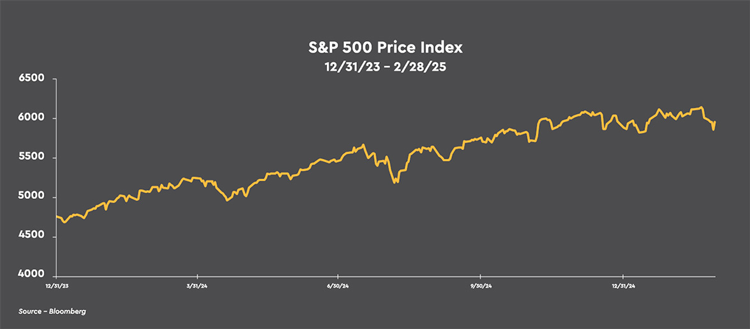
Since the new record high on the S&P 500 mid-month, downward pressure on stock prices has been driven by an unwind of excessive momentum and leverage in certain sectors of the stock market, particularly technology. Investors are sorting through many variables and are facing an unprecedented degree of policy unorthodoxy leading to a marked rise in uncertainty.
Tariff headlines are an everyday occurrence, while the more market friendly parts of the Trump policy agenda — deregulation and tax cuts — are still forthcoming.
Equity Markets
A Growth Scare and Tariff Concerns Weigh on Stock Prices
Investors, business leaders, and households have spent the last two months digesting the scope and velocity of President Trump’s efforts to pressure U.S. trading partners into meeting the administration’s demands on trade, national security issues, and immigration, shrink the size of the federal government, and reorient the trade norms of the global economy. Markets began the year optimistic that the incoming administration would reduce burdensome and expensive regulations, lower taxes, boost fossil fuel production, and revive dealmaking and domestic manufacturing.Initially, they tended to discount aspects of the President’s platform that they disliked, namely tariffs, and felt confident that the nation would benefit from GOP promises to bolster the economy. Now, they have become concerned about the possibility that the administration’s policies could boost prices, reduce labor supply and weigh on the economy’s forward momentum.
Common stock prices reached their post-election high in early December, but on average have fallen since then on renewed inflation concerns, signs of a deceleration in the economy’s growth rate, an AI-related selloff in technology shares, and what seems like an unending barrage of new tariff announcements.
Mid-month President Trump ordered federal agencies to explore how to adjust U.S. tariffs to match those of U.S. trading partners. The President said that for purpose of fairness, the U.S. “will charge a reciprocal tariff, meaning whatever countries charge the U.S., we will charge them, no more no less.” The reciprocal tariffs are not scheduled to go into effect for a couple months as studies will commence to determine the appropriate tariff levels for each trading partner.
The reciprocal tariff policy will treat other countries’ non-tariff barriers to trade as unfair trade practices that warrant tariffs in response. These non-tariff barriers include value-added taxes applied to U.S. imports, government subsidies, regulations that prevent U.S. companies from doing business in foreign countries, and any other business practice that the office of the U.S. Trade Representative deems to be unfair trade limitations.
The markets initially took the announcement in stride, likely because the reciprocal tariffs were not immediately imposed and should only result in moderate tariffs increases if implemented as many U.S. trading partners operate under free trade agreements. Additionally, there is the possibility that President Trump could use his reciprocal tariff plan to negotiate with trading partners to lower their tariffs and trade barriers as opposed to the U.S. increasing its tariffs. For instance, the European Union said last month it was ready to discuss cutting tariffs to avoid a trade war with Washington.
An obscure but noteworthy trade-related policy risk worth highlighting concerns the 1984 US-China income tax treaty, which exempts Chinese entities from paying tax on interest income earned in the U.S. In its recent “America First Trade Policy” memo, the Trump Administration directed the Treasury Secretary to review this agreement as a possible negotiating tool in discouraging U.S. investment in China’s military-industrial complex. If escalated, such a challenge could pose a downside risk for the bond market and global capital flows generally.
The trend in inflation has come under heightened scrutiny over the past four months due to signs of lingering inflationary pressures. The latest indication that progress on inflation has stalled was found in the January Consumer Price Index report, which rose 3.0% year-over-year compared to the recent trough of 2.4% in September, with the core CPI higher by 3.3% year-over-year. While much of the inflation print was driven by shelter inflation that does not necessarily reflect what is currently happening in the rental market, there is little question that the inflation report was an upside surprise.

The February reading on the University of Michigan consumer sentiment measure softened more than expected, falling back to pre-election levels. The one year inflation expectation rose sharply to 4.3% compared to 3.3% in January, the highest since 1995. The survey noted that consumers cited “fears that tariff-induced price increases are imminent.”
Likewise, the Conference Board Consumer Confidence Index fell for the third month in a row in February, bringing the Index to the bottom of the range that has prevailed since 2022. Consumers turned pessimistic about future business conditions and income, while pessimism about future employment prospects worsened. The twelve month inflation expectation surged from 5.2% to 6%, with write-in responses containing a sharp increase in mentions of trade and tariffs.
Last week, President Trump stated that the 25% tariffs on imports from Canada and Mexico “will go forward” this week because the countries had yet to curb the flow of drugs into the U.S. An additional 10% tariff on Chinese goods, on top of the previously announced 10% tariff on Chinese imports, would also be imposed because Beijing so far had not made a proposal to the Trump administration that showed a stepped up commitment to reduce China’s exports of chemicals used to make fentanyl.
Since the new record high on the S&P 500 mid-month, downward pressure on stock prices has been driven by an unwind of excessive momentum and leverage in certain sectors of the stock market, particularly technology. Investors are sorting through many variables and are facing an unprecedented degree of policy unorthodoxy leading to a marked rise in uncertainty. Tariff headlines are an everyday occurrence, while the more market friendly parts of the Trump policy agenda — deregulation and tax cuts — are still forthcoming.
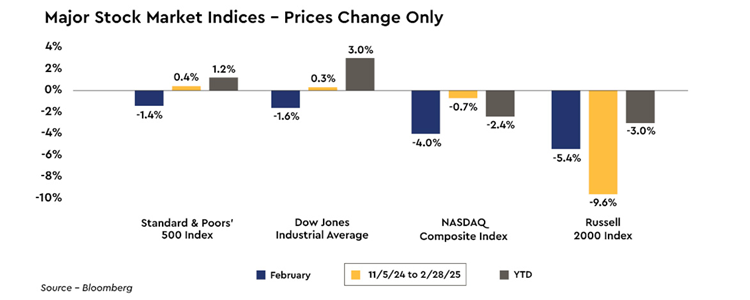
With stock prices regaining some footing as the month came to a close on an encouraging core personal consumption expenditures inflation reading — 2.6% year-over-year compared to 2.9% in January — and many beaten down stocks reaching oversold conditions, the major market measures recovered some of their February losses, closing lower by -1.4% to -5.4% for the month.
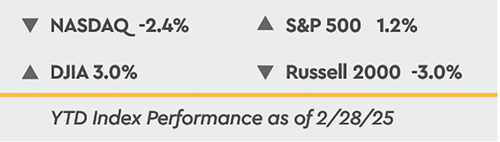
On the year-to-date, the S&P 500 and the DJIA are higher by 1.2% and 3.0%, while the NASDAQ Composite and the Russell 2000 are lower by -2.4% and -3.0%. Since the presidential election, the S&P 500 and the DJIA are higher by only 0.4% and 0.3%, while the NASDAQ Composite are the Russell 2000 have given up all of their post-election gains at -0.7% and -9.6%.
With the current growth scare in the economy, the decline in stock prices last month and the mixed results over the first two months of the year, it leads one to wonder how much, and for how long, will the Trump administration allow policy uncertainty, particularly on tariffs, to weigh on the outlook for the economy, and ultimately stock prices.
Federal Reserve Remains on Hold for the Time Being
A number of factors point to the Federal Reserve remaining in the current “wait and see” mode for the next few months. Reports on inflation show that progress on a further lowering of the nation’s inflation rate has stalled and that both market-derived and household surveys of inflation expectations have recently moved higher, supporting the Federal Reserve remaining on hold. Consider that implied inflation expectations on two-year and five-year Treasury securities have risen 84 and 71 basis points, respectively, since mid-September, with the two year inflation expectation approaching 3.0%.In testimony before the Senate Banking Committee last month, Chair Powell stated the Federal Reserve does “not need to be in a hurry to adjust our policy stance.” Mr. Powell called the economy “strong overall” with a “solid” labor market, and said “inflation is easing but remains above the central bank’s 2% target.” Chair Powell went on to say that the Federal Reserve could cut rates if the labor market weakened unexpectedly, or inflation made faster than expected progress toward the 2% target.
Officials at the Federal Reserve are uneasy about the recent sticky inflation readings and are clearly anxious about the potential impact from tariffs. The minutes of the January FOMC meeting stated that participants saw risks to inflation as skewed to the upside, partly reflecting the effects of potential changes in tariff and immigration policy. The FOMC Committee is likely questioning how much inflationary pressure remains in the pipeline and whether they have a policy setting sufficiently restrictive to bring inflation down to the 2% target.
However, things could change quickly. The recent small cracks in the growth narrative for the economy bear watching. Should the mounting uncertainty for both the business community and the household sector feed upon itself, the economy could easily approach stall speed in rapid order. This could pressure the jobs market and bring rate cuts back into play by the summer.
The Economy and Earnings Remain the Keys to the Outlook for Common Stocks
At SouthState Wealth, it is not our role to opine on what the Executive branch and Congress should do, or if we agree or disagree with particular policies. Our role is solely to try to understand the impact on the economy and the financial markets from what the policymaking branches of the Federal government do. So far, with little policy enacted, but quite a bit offered up in press conferences and on social media, the markets have been forced to react to the possibilities of what policy could turn out to be.The most controversial of President Trump’s policies is to raise or impose new tariffs on trading partners. We continue to view tariffs as having little support among businesses and households. However, there appears to be some reluctant acceptance of tariffs that address unfair trade practices, that attempt to protect critical industries vital to the security of the U.S., and when used as negotiation tools for policy objectives.
Business, small and large, are currently being impacted by the uncertainty regarding the eventual array of policies that the White House and Congress will enact. Decisions about hiring and investments ultimately are judgments about whether the risk is worth taking for the potential return. Policy uncertainty is making those judgments more difficult, leading to some hesitation on the part of business leaders. Consumer confidence gave back its post-election bump largely due to tariff threats and tariff-related pricing concerns.
With policy uncertainty particularly high currently, the general mood of investors appears to be somewhat unsettled or confused, not knowing which policies will actually become law. Investors are looking forward to a time when the economic and policy environment settles into a new steady state that can be relied upon and built upon rather than a constant salvo of policy announcements that raise uncertainty and make planning and investment decisions more difficult.
The economy’s growth rate is expected to slow to a pace in the range of 1.5% to 2.0% this year compared to a growth rate of 2.5% in 2024, although the risks currently appear to be to the downside. The base driving consumer spending has narrowed, businesses have become somewhat hesitant, and housing continues to suffer from affordability conditions.
We still expect that common stocks should benefit from the macroeconomic backdrop going forward, even with periods of volatility brought on by President Trump’s unconventional approach to policymaking. With a president that tends to keep score on the basis of economic growth and stock prices, we expect the Trump administration’s policy mix will ultimately be positioned and implemented in a manner that is beneficial to the economy, earnings, and common stock prices. However, the policy uncertainty gives any outlook an inherently wider error band currently.
We have held the position for the past few months that returns on common stocks this year would likely be determined by the trade off between the higher level of Treasury yields and Corporate America delivering a third consecutive year of strong earnings growth. That is still our position.
First on Treasury yields, the two-year Treasury yield ended February at 4.0%, hitting the lower end of the 4.0% to 4.4% range since the election. Likewise, the yield on the ten-year Treasury note has ranged between 4.15% and 4.79% since the election, ending February at 4.21%, just above the lower end of the range. So, while Treasury yields remain above the lows recorded back in mid-September — 3.55% for the two-year Treasury and 3.64% for the ten-year Treasury — they have not offered incrementally more competition for common stocks so far in 2025.
The 4Q 2024 earnings season has been stellar. With 97% of the S&P 500 companies reporting, 4Q 2024 operating earnings are expected to be higher by 14.4% on a year-over-year basis, with 75% of reporting companies beating the consensus earnings estimate. The analysts at Standard & Poor’s are forecasting that operating earnings will grow by roughly 14% over the four quarters of 2025. Earnings growth is expected to drive stock prices this year, not an increase in price-to-earnings multiples.
The major risk to stock prices over the next year or so would be the Federal Reserve needing to shift policy to a more restrictive policy stance to fight a rekindling of inflationary pressures, which would likely reset common stock prices lower. However, that risk appears to be rapidly falling as the data increasingly points to the economy’s growth rate decelerating. The current growth scare could return investor focus to rate cuts in short order.
The markets could get hit with another bout of uncertainty this month as the stopgap federal government funding bill that was signed into law on December 21 averted a government shutdown, but expires on March 14. Many political analysts expect the federal government to shut down in mid-March because a bipartisan deal on government funding appears to be unlikely with the Democratic party likely to demand major Department of Government Efficiency concessions that Republicans are unlikely to agree to.
Once again, the electorate and the operation of the federal government will be held hostage to which side blinks first as attempts are made by both sides to blame the other for the shutdown. The political climate in Washington currently could very possibly result in an extended shutdown of the federal government.
Common Stocks Are a Long Run Investment
Participants in a capitalistic economy have strong self-interest to grow, leading businesses, large and small to consistently innovate, create, and drive efficiencies which leads to higher levels of earnings. The growth in earnings over the past two years following the earnings recession of 2022, despite high and rising interest rates and inflation running above the central bank’s 2% target, is a testament to the growth dynamics of the U.S. capitalistic economy. As companies continue to generate earnings and ramp the pace at which earnings can grow, common stock prices will naturally rise over time.Innovation, creativity, profit motives, and the desire for higher standards of living are the true engines of economic growth, earnings, and stock prices. Long-term investors benefit from the intrinsic value of high quality companies rising over time, not from speculation or excessive risk taking. The keys to building wealth are that long term investors need to withstand the tendency for common stocks to be inherently volatile in the short run — view it as the price of admission — and to maintain a steady hand during periods of below average returns, and stay invested, allowing returns to compound for the longest possible period of time.
Growth Scare Pushes Treasury Yields Lower
Yields on Treasury securities rose in a fairly persistent manner from mid-September to mid-January. Two-year Treasury yields rose solely on rising inflation fears as 100% of the rise was accounted for by higher inflation expectations. Likely the stall in the progress in lowering the economy’s inflation rate since September and the likelihood of higher tariffs were the reasons for inflation expectations moving higher.Yields on ten-year Treasury securities rose for a variety of reasons. Inflation concerns definitely played a role as about 30% of the rise in yields reflected an increase in inflation expectations. Roughly 70% of the rise in ten-year Treasury yields was accounted for by a rise in real yields as investors expected the policy agenda of the Trump administration to bolster the economy’s growth rate, but at the expense of increasing the outsized federal budget deficits even further.
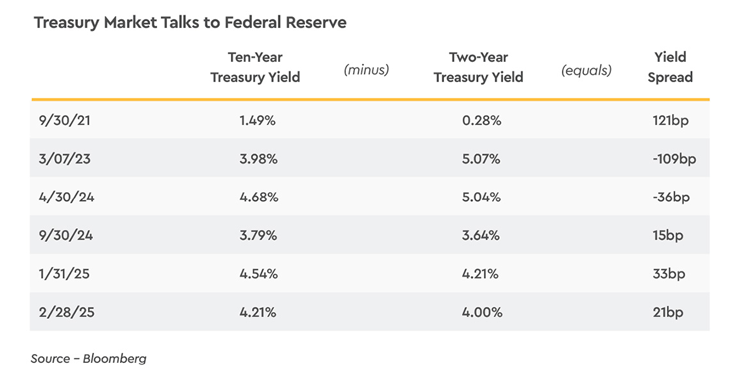
Yields on Treasury securities reversed course over the past seven weeks, however, as the tone of the market shifted. The yield on the ten-year Treasury fell 33 basis points to 4.21% last month, while the two-year Treasury yield fell 21 basis points to 4.00% as real yields fell more than the drop in nominal yields on both securities. Investors seemed worried about the spate of weaker than expected economic data and began to factor in the possibility that the Federal Reserve could resume rate cuts as soon as the June 17-18 FOMC meeting.
Data suggesting that a fairly significant softening in consumer sentiment is leading to a slowdown in consumer spending, along with widespread weakness in housing, signs of businesses delaying capital spending plans, and a softening labor market, raised concerns about the extent to which a downshift in the economy could be underway.
Consider also that at the end of January, the yield on the two-year Treasury note at 4.21% was only 17 basis points below the 4.38% midpoint of the current target range of the federal funds rate. This meant that the market was assigning a roughly 70% probability of another 25 basis point cut in rates by the Federal Reserve. At the end of February, the two-year Treasury note yield of 4.00% was 38 basis points below the midpoint of the target range, implying that the market was expecting between one and two additional 25 basis point rate cuts in response to a softening of the economy’s growth rate.
In our opinion, the policy uncertainty flowing from Washington, particularly as it relates to tariffs, is almost solely responsible for the emerging cracks in the economy’s forward momentum. Treasury yields will likely remain under downward pressure, particularly in the two to five year portion of the yield curve as the market could price in additional rate cuts, until the cloud of uncertainty lifts. Lower yields on ten-year Treasury securities will require an easing of the inflation data to allow inflation expectations to be repriced lower.